

TL;DR:
- Retail fixtures significantly influence inventory turnover by enhancing product visibility and customer navigation. Proper placement and execution can boost sales by up to 15%, but overcrowding and misplacement hinder performance. Measuring SKU-level sales velocity and maintaining operational discipline are essential for maximizing fixture-driven sales growth.
Retail fixtures are a direct driver of inventory turnover, determining how quickly products move off shelves by shaping visibility, customer navigation, and purchase behaviour in-store. When fixtures impede findability, sales slow and stock sits longer, cutting into margin and cash flow. The relationship between shopfitting choices and sales velocity is not incidental. It is structural. This guide explains the mechanisms behind that relationship, the common mistakes that undermine it, and the practical steps retail managers can take to measure and improve fixture-driven turnover in 2026.
Why retail fixtures affect turnover: the core mechanisms
Retail fixtures shape turnover through four interconnected forces: product visibility, customer navigation, dwell time, and purchase triggers. Understanding each one gives you a clearer picture of where your shopfitting decisions are either working for you or against you.
Product visibility and findability sit at the foundation. A fixture that positions a product at eye level, faces it correctly, and keeps it well-lit increases the probability that a shopper notices it. A fixture that buries a product behind a structural column or crowds it alongside twenty competing SKUs does the opposite. Retail display effectiveness ties directly to sales velocity: when customers cannot find or see a product, it does not sell, and turnover declines.
- Circulation and dwell time. Optimised store circulation increases dwell time by 10% to 20% and average basket size by 5% to 12%. Longer dwell time means more product exposure, which translates directly into faster inventory movement.
- Point-of-purchase triggers. POP displays placed in high-traffic areas increase in-store conversions during their deployment period. The mechanism is impulse activation: a well-positioned display intercepts a shopper mid-journey and converts a passive browser into a buyer.
- Spatial comfort. Overcrowded aisles suppress sales. Research shows that in-aisle display stands increase perceived crowding, particularly for customers with trolleys, reducing product interaction and lowering sales velocity in that zone.
The interplay between these forces is what makes fixture strategy genuinely complex. You cannot optimise one in isolation. A display that lifts visibility but blocks circulation will gain on one metric and lose on another. Treat fixture-driven turnover as a system effect where circulation, adjacency, and product discovery are intertwined elements influencing sales velocity together.
Pro Tip: Map your store’s customer flow before placing any new fixture. Identify the natural walking path from entrance to checkout and position high-margin products along that route, not off it.

How does fixture placement boost sales turnover?
Smart fixture arrangement is where the theory of visual merchandising effects becomes measurable revenue. The evidence is clear: layout optimisation can increase sales by up to 15% by improving navigation and product visibility. That figure represents a significant uplift for any retail business, and it comes not from stocking different products but from presenting existing ones more effectively.
The table below summarises the key fixture placement principles and their documented impact on turnover-related metrics.
| Placement principle | Mechanism | Documented impact |
|---|---|---|
| Eye-level positioning | Increases product noticeability and interaction | Higher sales velocity for featured SKUs |
| High-traffic zone displays | Intercepts shoppers at peak attention moments | Increased conversions during display period |
| Optimised aisle width | Reduces crowding and maintains shopper comfort | Sustained product interaction and sales flow |
| Circulation-led layout | Guides shoppers past more product categories | Dwell time up 10%–20%, basket size up 5%–12% |
| Consistent planogram adherence | Maintains predictable product location for repeat visitors | Repeatable turnover performance across store visits |
Data-driven approaches to layout, including heat maps and visitor flow analysis, remove the guesswork from these decisions. Tools used by retail analysts at firms like Ariadne translate foot traffic patterns into fixture placement recommendations that directly correlate with faster product movement. For retail chains in particular, consistent circulation and fixture layout strategies establish predictable customer flow and repeatable turnover performance across multiple locations.
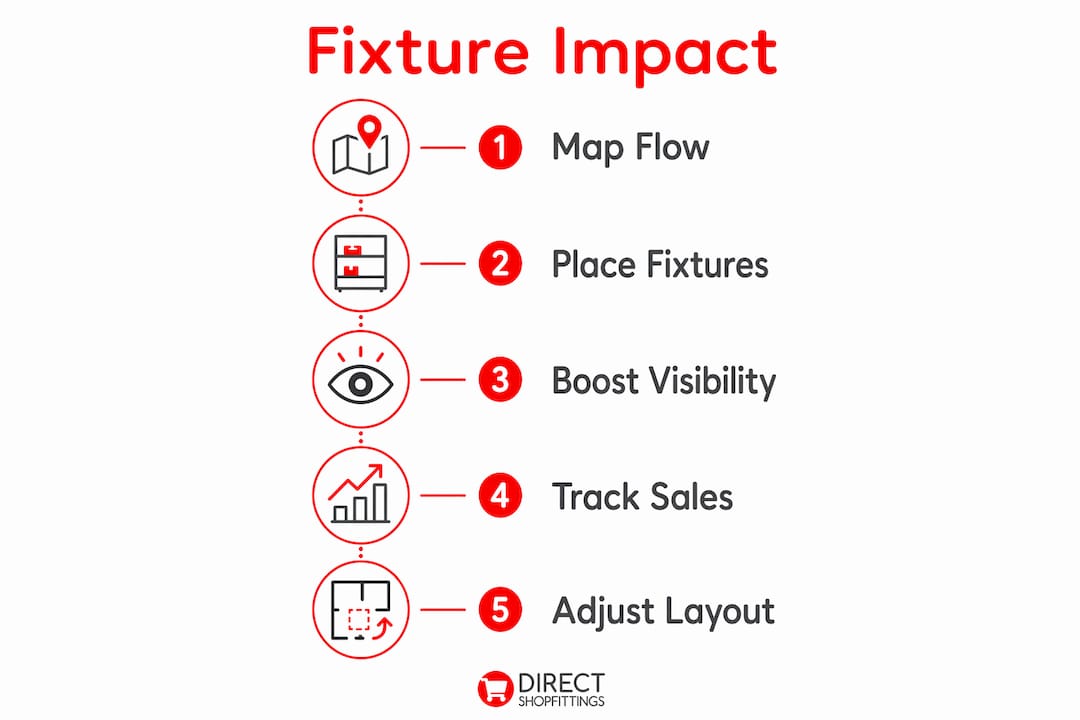
Balancing exposure with comfort is the discipline that separates effective visual merchandising from counterproductive clutter. Adding more fixtures to a space does not automatically increase turnover. The goal is to maximise product exposure per square metre while preserving the ease of movement that keeps shoppers browsing rather than retreating.
Pro Tip: Use a simple heat map tool or ask your team to observe and record where customers spend the most time. Reposition your highest-margin fixtures to those zones and measure the sales velocity change over a four-week period.
What fixture mistakes reduce turnover?
The most damaging misconception in retail shopfitting is that more visibility always produces more sales. It does not. Spatial crowding creates discomfort and lowers purchase frequency, particularly for shoppers navigating with trolleys or pushchairs. A store that feels difficult to move through sends customers to the exit, not the till.
Beyond overcrowding, the most common fixture errors that suppress turnover fall into three categories.
- Misplacement. Fixtures positioned without reference to customer flow interrupt natural navigation. A promotional stand placed at the entrance to a narrow aisle creates a bottleneck rather than a conversion opportunity. Shoppers avoid the zone entirely, and the products on that fixture see no uplift.
- Poor replenishment. An empty or half-stocked fixture signals neglect and removes the product from the shopper’s consideration set entirely. Execution failures such as misplacement, poor replenishment, and ignoring store circulation consistently undermine fixture effectiveness, regardless of how well-designed the fixture itself is.
- Ignoring before-and-after data. Many retail teams deploy new fixtures without establishing a baseline. Without comparing sales during a fixture period against a control period or a comparable store without the fixture, there is no way to verify whether the investment is driving turnover or simply adding cost.
The retail display mistakes that small stores make most often are not about fixture quality. They are about fixture execution. A gondola shelving unit placed correctly, stocked consistently, and positioned within a logical product adjacency will outperform a premium display unit that is poorly located and irregularly replenished.
How can managers measure fixture impact on turnover?
Measuring the impact of fixtures on turnover requires a shift in focus from total sales to sales velocity per SKU. Total sales figures obscure the contribution of individual fixtures. Velocity metrics, which track how quickly a specific product moves over a defined period, isolate the fixture effect with far greater precision.
- Establish a baseline. Before deploying a new fixture or repositioning an existing one, record the sales velocity for the affected SKUs over a minimum of four weeks. This baseline is your control data.
- Run a before-and-after comparison. Deploy the fixture change and measure the same SKUs over an equivalent period. A meaningful uplift in velocity that cannot be explained by seasonal variation or promotional activity points to the fixture as the driver.
- Use a control store. For retail chains, comparing sales velocity per SKU between a store with the fixture change and one without it removes external variables and gives a cleaner read on fixture contribution.
- Track customer attention metrics. Dwell time in a fixture zone, product interaction rates, and conversion from browse to purchase are leading indicators of turnover improvement. These signals appear before the sales data catches up, giving you an earlier diagnostic read.
- Coordinate replenishment with fixture deployment. A fixture that runs out of stock mid-measurement period invalidates your data and suppresses the turnover it was designed to drive. Planogram adherence and replenishment scheduling must be locked in before the measurement window opens.
For managers looking at gondola shelving setup or floor fixture arrangements, the measurement framework above applies regardless of fixture type. The principle is consistent: isolate the variable, measure velocity, and adjust based on what the data shows rather than what looks appealing on the shop floor.
Pro Tip: Combine turnover velocity data with customer attention metrics such as dwell time and product touch rates. This diagnostic pairing tells you not just whether a fixture is working, but why it is or is not performing.
Key takeaways
Retail fixtures drive turnover by shaping product visibility, customer flow, and purchase triggers, and their impact is measurable through sales velocity, dwell time, and basket size metrics.
| Point | Details |
|---|---|
| Fixtures drive sales velocity | Poor visibility and findability directly slow product movement and reduce turnover. |
| Layout optimisation lifts sales | Data-driven fixture placement can increase sales by up to 15% through better navigation and exposure. |
| Crowding suppresses turnover | In-aisle displays that restrict movement reduce product interaction and lower sales in that zone. |
| Execution determines results | Misplacement and poor replenishment undermine even well-designed fixture programmes. |
| Measure velocity, not just sales | Tracking SKU-level sales velocity before and after fixture changes isolates the true turnover impact. |
Fixtures as conversion infrastructure, not decoration
After years of working with retail businesses across formats and sizes, the pattern I keep seeing is the same. Fixture investment gets treated as a shopfitting cost rather than a sales performance lever. Managers spend carefully on stock, staffing, and promotions, then place fixtures based on what looks tidy rather than what drives product movement. The results are predictable: turnover stays flat, and nobody connects it to the shelving layout.
The shift that makes a genuine difference is treating fixtures as conversion infrastructure. Every fixture placement decision is a hypothesis about customer behaviour. Where will shoppers walk? What will they notice? What will prompt them to pick something up? When you frame it that way, the measurement discipline follows naturally. You would not run a promotional campaign without tracking its effect on sales. The same logic applies to a new display stand or a repositioned gondola unit.
What I have also found is that execution consistency separates the retailers who see fixture-driven turnover gains from those who do not. The best-designed display in the right location will still underperform if it is half-empty on a Tuesday afternoon or if the planogram gets ignored after the first week. The fixture is only as effective as the operational discipline behind it. For retail leaders reading this, the conversation worth having with your team is not just about which fixtures to buy. It is about how you will maintain, stock, and measure them once they are in place.
— Lee
How DirectShopfittings can support your fixture strategy
If the evidence in this article has prompted you to reconsider your current fixture setup, DirectShopfittings offers the range and expertise to act on that thinking practically.
DirectShopfittings supplies retail fixtures and equipment suited to businesses from independent boutiques to large retail chains, with competitive pricing and rapid delivery that makes it straightforward to test and iterate on fixture placement without long lead times. Their supplier network means hard-to-source items are accessible without the delays that typically stall a shopfitting project. Whether you are reconfiguring a floor layout, adding point-of-purchase displays, or upgrading gondola shelving, you can explore the full range and get guidance on selecting the right supplier for your specific store format and turnover goals.
FAQ
What is the link between retail fixtures and inventory turnover?
Retail fixtures directly influence how quickly products sell by affecting visibility, findability, and customer navigation. When fixtures are well-positioned, products move faster and inventory turnover improves.
Can poor fixture placement actually reduce sales?
Yes. In-aisle displays that create crowding reduce product interaction and lower sales velocity, particularly in zones where shoppers navigate with trolleys.
How much can layout optimisation improve sales?
Data-driven layout improvements can increase sales by up to 15% through better navigation and product exposure. This uplift comes from presenting existing stock more effectively, not from changing the product range.
What is the best way to measure fixture impact on turnover?
Track sales velocity per SKU before and after a fixture change, and use a control store comparison where possible. This approach isolates the fixture contribution from seasonal or promotional variables.
Why do fixture programmes fail despite good design?
Execution failures including poor replenishment, misplacement, and inconsistent planogram adherence are the most common reasons well-designed fixture strategies do not deliver turnover gains.