
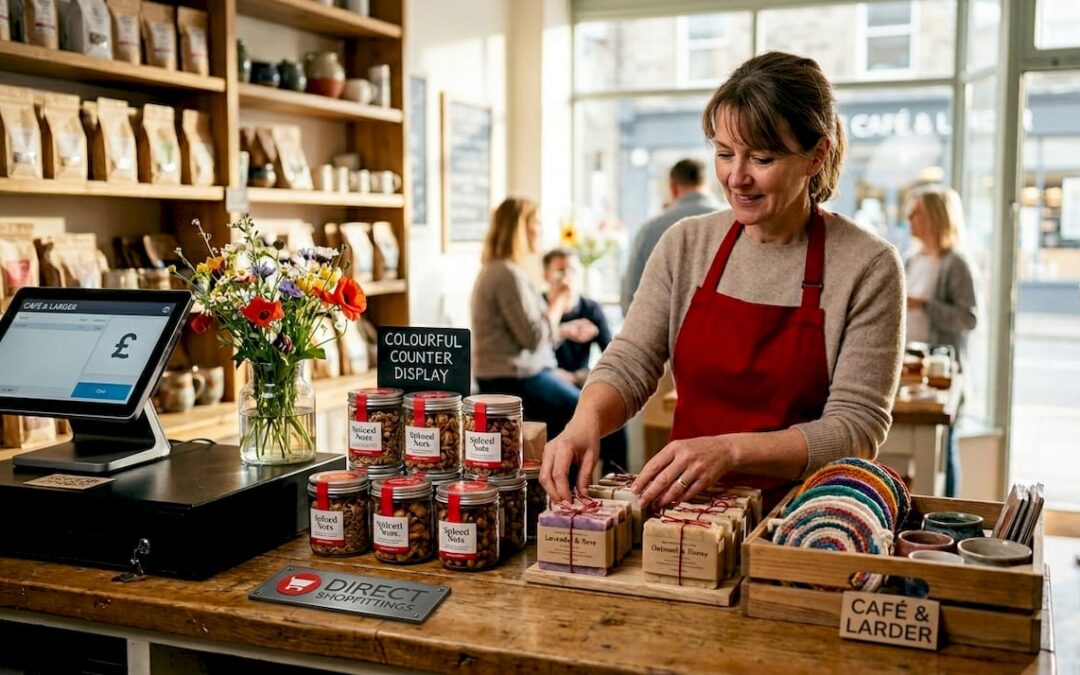
Retail counter displays are point-of-purchase fixtures positioned at checkout or service counters to convert shopper intent into immediate sales. The core retail counter display benefit is placement: products appear exactly where buying decisions occur, not somewhere a customer might wander past. Research from Brown Packaging confirms that counter displays capture attention at the moment of purchase rather than simply attracting it during browsing. That distinction separates a display that sells from one that merely decorates. For retail managers weighing up display strategy, the evidence points clearly toward the checkout counter as the highest-converting location in the store.
1. Retail counter display benefits: why placement drives sales
Counter displays outperform many other in-store formats because they exploit a specific psychological window. When a shopper reaches the checkout, their decision to spend money is already made. A well-placed counter display presents additional products at precisely that moment of open-wallet readiness.
Brown Packaging’s analysis shows that counter displays place products where purchase decisions occur, requiring minimal effort to convert intent into a transaction. This is the fundamental advantage of counter displays over floor or shelf units: the shopper is already committed to buying, so the psychological barrier to adding one more item is at its lowest.
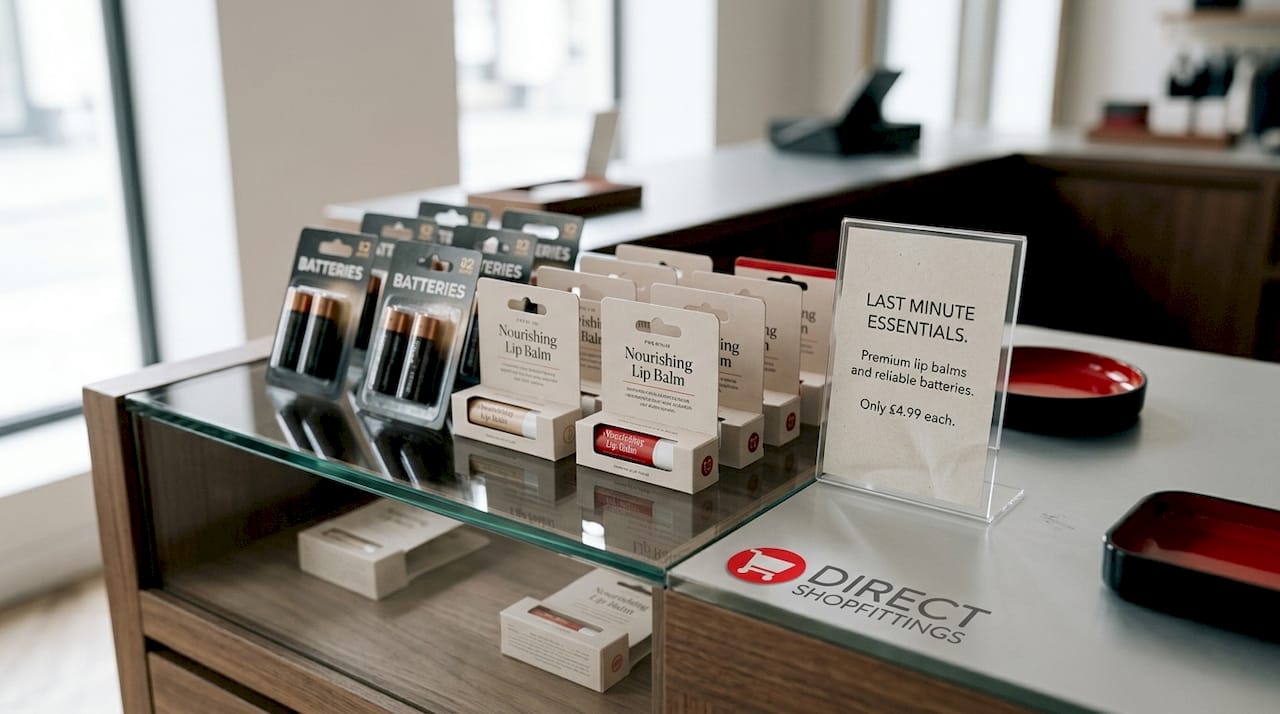
The advantages of counter displays extend beyond psychology. They require no additional floor space, cost less to produce than floor-standing units, and can be restocked quickly during a quiet moment between customers. For small boutiques and convenience stores alike, that combination of low cost and high conversion makes counter displays one of the most efficient tools in retail merchandising.
2. How counter displays influence impulse purchases
Impulse purchasing is not random. Shoppers are most susceptible to unplanned purchases when their attention is captured at a moment of low cognitive resistance, and the checkout queue is exactly that moment. Products displayed at eye level or within easy reach of the counter trigger what retail researchers call point-of-decision purchasing.
Key factors that drive impulse buys at the counter include:
- Proximity to payment: The physical act of paying lowers resistance to small additional purchases.
- Reduced browsing effort: Products are presented rather than searched for, removing friction.
- Curated selection: A small, focused product set prevents decision fatigue.
- Clear signage: Benefit-led labels answer the shopper’s unspoken question: “Why do I need this?”
Eye-tracking research shows that transparent packaging attracts faster and longer visual attention, and leads to higher perceived product quality and purchase intention. Choosing packaging with a visible product window for counter display items is therefore a direct merchandising lever, not just an aesthetic preference.
Pro Tip: Prioritise small, high-margin items such as batteries, lip balm, travel accessories, or confectionery for counter displays. These categories have low price resistance and high impulse appeal, making them ideal for point-of-purchase placement.
3. Space efficiency and cost advantages for retailers
One of the most practical benefits of in-store displays at the counter is their minimal footprint. A counter display occupies the surface area of the counter itself, leaving floor space free for browsing fixtures, queuing customers, or additional product ranges.
Brown Packaging’s industry analysis confirms that counter displays are cheaper to produce, easier to set up, and better suited to limited retail footprints than floor-standing alternatives. For a small boutique or a convenience store with tight square footage, this is a significant operational advantage. A floor display might require a dedicated zone, staff to manage it, and a higher upfront investment. A counter unit can be placed, filled, and trading within minutes.
The practical benefits for retail businesses include:
- Lower production and material costs compared to floor displays, enabling faster rollout across multiple locations.
- Simpler setup and maintenance, reducing the risk of poor execution by staff with limited visual merchandising training.
- Flexible product assortment, allowing quick swaps to reflect seasonal promotions, new product launches, or clearance lines.
- Easier restocking during trading hours without disrupting the shop floor.
Pro Tip: Match the physical size of your counter display to the available counter space. A display that crowds the payment area frustrates customers and staff alike. Leave clear space around the unit for comfortable interaction.
4. Counter displays vs floor displays: which should you use?
Understanding when to use a counter display versus a floor display is one of the most practical counter display merchandising tips a retail manager can apply. Both formats serve different purposes and work best for different product types.
| Factor | Counter display | Floor display |
|---|---|---|
| Placement | Checkout or service counter | Shop floor, aisle end, or entrance |
| Best product type | Small, high-margin impulse items | Larger, considered-purchase products |
| Space required | Minimal (counter surface only) | Significant floor area |
| Production cost | Lower | Higher |
| Shopper interaction | At point of payment | During browsing phase |
| Setup complexity | Simple | More involved |
Counter displays win on cost, speed, and conversion at checkout. Floor displays win on visibility across the shop floor and suitability for bulkier products. The most effective retail display strategy combines both: floor displays attract shoppers to a category during browsing, and counter displays close the sale at checkout.
Common mistakes retailers make in display choice include placing large, complex floor units near the counter where they crowd the payment area, and using counter displays for products that require considered decision-making, such as high-value electronics or items needing size selection. Research from the University of Innsbruck found that confined shopping spaces reduce perceived control and negatively affect purchasing behaviour. Crowding the counter area with oversized displays produces the same effect.
A field study found that removing excessive secondary displays increased supermarket sales by 11.5% despite fewer products being shown. The lesson for counter display design is clear: restraint in display quantity and size directly supports sales performance.
5. Merchandising tips to maximise counter display effectiveness
Knowing how to use counter displays well separates retailers who see a modest uplift from those who see a consistent sales increase. The following practices are grounded in current retail behaviour research and practitioner experience.
1. Curate a tight product selection. A tight product set of 5 to 10 SKUs with clear, benefit-first signage is the standard recommended by display design specialists. More products create visual noise and slow decision-making.
2. Use transparent or product-visible packaging. As noted in eye-tracking research, packaging that shows the product inside leads to higher purchase intention and perceived quality. Where possible, select or request packaging formats that allow the product to be seen.
3. Maintain display neatness throughout trading hours. A depleted or dishevelled display signals neglect and reduces perceived product value. Assign a specific restocking check at opening, midday, and closing.
4. Avoid overcrowding the counter area. Research confirms that excessive displays worsen spatial constraints and reduce browsing. A single, well-curated counter display outperforms three competing units fighting for the same space.
5. Integrate with your POS layout. Position the display so it is visible to the customer while they wait to pay, not tucked behind the till where only the cashier can see it. Pairing counter displays with a well-configured POS system allows you to track which counter products are selling and adjust the assortment accordingly.
6. Use benefit-driven signage. “Protects your lips in cold weather” outperforms “Lip balm £1.50” every time. Shoppers at the counter are not browsing; they need a fast reason to add an item to their purchase.
7. Rotate product selection regularly. Regular customers notice when the counter display never changes. Rotating products monthly keeps the display fresh and creates repeat impulse purchase opportunities.
Pro Tip: Spend ten minutes observing shopper behaviour at your counter during a busy period. Watch where eyes go, what gets picked up, and what gets ignored. That observation will tell you more about display positioning than any planogram.
A quantitative study of convenience store customers found that display design and product assortment are stronger drivers of purchase intention than product location within the store. Getting the design and selection right matters more than simply having a display present.
Key takeaways
Counter displays convert sales most effectively when products are curated, clearly signed, and positioned within the shopper’s line of sight at the payment point, with enough clear space to avoid crowding.
| Point | Details |
|---|---|
| Placement drives conversion | Counter displays work because they reach shoppers at the moment of purchase, not during browsing. |
| Less is more on the counter | A tight selection of 5 to 10 SKUs outperforms a crowded display with more products. |
| Space and cost advantages | Counter displays cost less to produce and require no floor space, making them ideal for small-format retail. |
| Packaging choice matters | Transparent or product-visible packaging increases visual attention and purchase intention at the counter. |
| Design beats location | Display design and product assortment are stronger purchase drivers than where in the store the display sits. |
What I have learned from watching counters sell
Lee’s perspective on counter display strategy is shaped by one observation repeated across dozens of retail environments: the retailers who get the most from their counter displays are the ones who treat the checkout as a selling zone, not a processing zone.
Most shop owners think about the counter as a place to complete a transaction. The best retailers think of it as the last and most persuasive shelf in the store. That shift in thinking changes everything from product selection to signage to how often the display gets restocked.
The most overlooked factor is shopper comfort. I have seen beautifully designed counter displays fail because the counter was already cluttered with card machines, loyalty card stands, and promotional leaflets. The display had no room to breathe, and neither did the customer. Clearing the counter before adding a display is not optional; it is the first step.
The second thing most retailers underestimate is the value of observation. Sales data tells you what sold. Watching the counter tells you why. A product that gets picked up and put back repeatedly is not failing because of low demand; it is failing because of price, packaging, or positioning. Those are fixable problems, but only if you are watching.
Start with one display, one product category, and one month of consistent restocking and observation. The data you gather in that period will be worth more than any planogram.
— Lee
Explore counter display solutions from DirectShopfittings
If the strategies above have prompted you to review your counter merchandising setup, the right equipment makes implementation straightforward.
DirectShopfittings supplies a full range of retail display equipment designed for practical, high-impact counter merchandising. From compact acrylic units to tiered counter stands, their product range covers the needs of independent boutiques and multi-site retail chains. Their supplier network means hard-to-find display formats are sourced efficiently, saving you time and procurement cost. Rapid delivery and a strong customer service reputation mean your display is trading quickly rather than sitting in a backlog. Browse the full range of retail display equipment at DirectShopfittings to find the right counter solution for your store.
FAQ
What are the main benefits of counter displays in retail?
Counter displays place products at the point of purchase, where shopper intent to buy is already active. This positioning drives impulse purchases, requires minimal floor space, and costs less to produce than floor-standing alternatives.
How many products should a counter display hold?
A tight selection of 5 to 10 SKUs is recommended by display design specialists at Brown Packaging. More products create visual noise and slow the decision-making process at checkout.
Do counter displays work better than floor displays?
Counter displays outperform floor displays for small, high-margin impulse items at checkout. Floor displays are better suited to larger products requiring considered purchase decisions during the browsing phase.
How does crowding affect counter display performance?
Research shows that removing excessive secondary displays increased supermarket sales by 11.5% despite fewer products being shown. Overcrowding the counter area reduces shopper comfort and lowers conversion rates.
What products work best on a retail counter display?
Small, high-margin items with low price resistance work best. Common examples include confectionery, batteries, lip balm, travel accessories, and seasonal add-ons that complement the store’s primary product range.