

Most store owners think of fixtures as shelves. They are not. Retail floor fixtures are one of the most powerful selling tools in your shop, yet they rarely get the strategic attention they deserve. Understanding what retail floor fixtures are, how they work, and which types suit your products can genuinely change how shoppers move through your store and what they buy. This guide covers everything from definitions to practical selection advice, so you can make smarter decisions about your store layout from the ground up.
Table of Contents
- Key takeaways
- What are retail floor fixtures and why they matter
- Types of retail fixtures and their functions
- Fixtures, planograms, and visual merchandising
- How to choose the right fixtures for your store
- Practical ways to get more from your fixtures
- My honest take on fixtures and small retail
- Find the right fixtures with Directshopfittings
- FAQ
Key takeaways
| Point | Details |
|---|---|
| Fixtures are selling tools | Floor fixtures are designed to prompt shopper actions, not just hold stock. |
| Multiple fixture types exist | Gondolas, slatwall panels, spinner racks, and endcaps each serve distinct merchandising purposes. |
| Eye-level placement drives sales | Products positioned at eye level on fixtures can generate significantly more sales than lower shelves. |
| Planograms guide fixture use | Linking fixtures to a planogram reduces placement errors and keeps your layout consistent. |
| Fixture choice affects shopper flow | The type, size, and position of fixtures directly influences how customers move through your store. |
What are retail floor fixtures and why they matter
The industry term you will encounter most often is merchandising fixtures or shop fittings. The phrase “retail floor fixtures” describes the same thing from a layout perspective: purpose-built store fixtures used on the sales floor to hold, organise, and visually merchandise products in ways that prompt shoppers to pick up, compare, or buy.
The distinction from back-stock shelving is worth making clearly. Back-stock shelving lives in your stockroom. It is purely functional. Floor fixtures, by contrast, are engineered for the sales floor, where every design choice, height, spacing, material, and angle, exists to influence shopper behaviour.
These fixtures come in a range of materials. Metal, wood, wire, and acrylic are the most common, and each brings different visual qualities and load capacities. A typical shelf carries between 25 and 75 pounds, and fixtures must also meet accessibility standards by keeping aisle spaces clear and products reachable. The material you choose signals something to your customer too. Warm timber feels boutique. Chrome wire feels contemporary. Neither is wrong. Both are deliberate.
Common examples you will encounter include:
- Gondolas: Double-sided freestanding units common in grocery and pharmacy retail
- Endcaps: Display units positioned at the end of gondola runs, ideal for promotions
- Slatwall panels: Slotted wall or freestanding panels that accept interchangeable hooks, shelves, and brackets
- Spinner racks: Rotating freestanding units suited to small items like keyrings, cards, or accessories
- Pegboard hooks: Lightweight hook systems mounted to boards or slatwall, perfect for packaged goods
Each of these does a specific job in guiding shoppers through what the shopper decision stages describe as browse, compare, grab-and-go, and cross-sell.
Types of retail fixtures and their functions
Understanding the different types helps you match the right fixture to the right product and the right moment in the shopper journey.
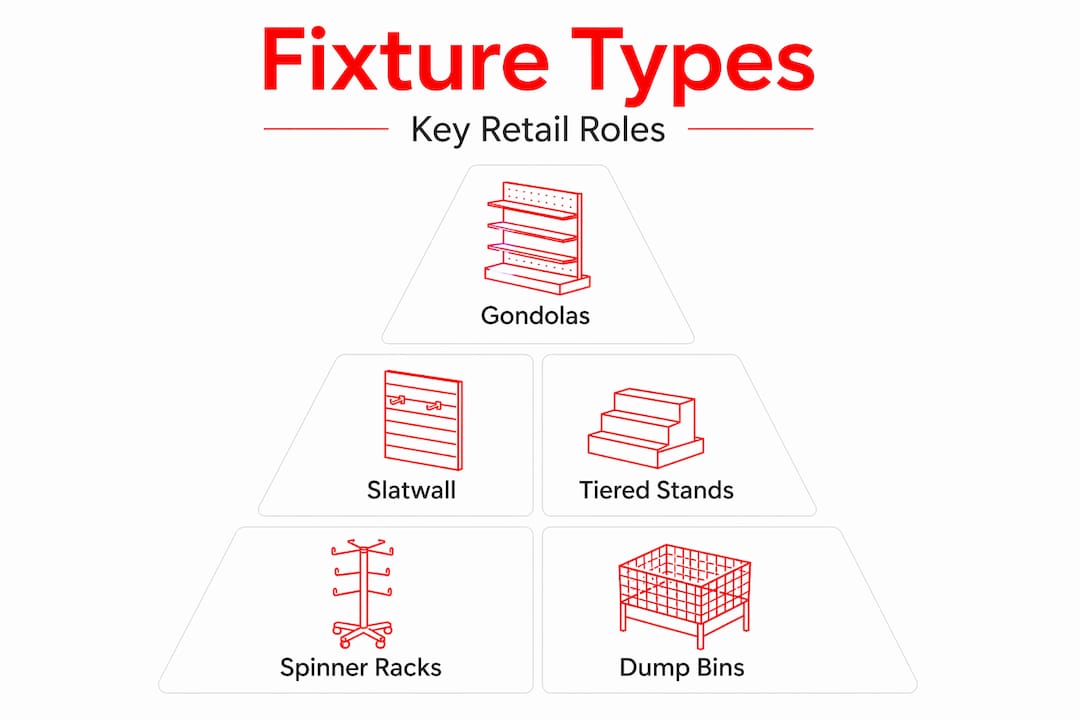
| Fixture type | Primary function | Best suited for |
|---|---|---|
| Gondola | High-capacity product display, double-sided | FMCG, grocery, pharmacy |
| Endcap | Promotional display at aisle ends | Featured products, seasonal ranges |
| Slatwall panel | Flexible, reconfigurable display | Clothing, accessories, mixed categories |
| Spinner rack | 360-degree browsing for small items | Cards, gifts, accessories, books |
| Tiered stand | Layered visibility for smaller products | Cosmetics, confectionery, health products |
| Pegboard | Lightweight hook-based display | Packaged goods, tools, hardware |
| Dump bin | Open-top bin for loose or discounted items | Clearance, impulse buys |
Gondolas are the workhorses of retail. Their double-sided design means you can merchandise two product categories back-to-back, and their adjustable shelving makes them adaptable as your range changes. Endcaps are premium real estate. Shoppers naturally pause at aisle ends, making these positions ideal for new launches or high-margin products.
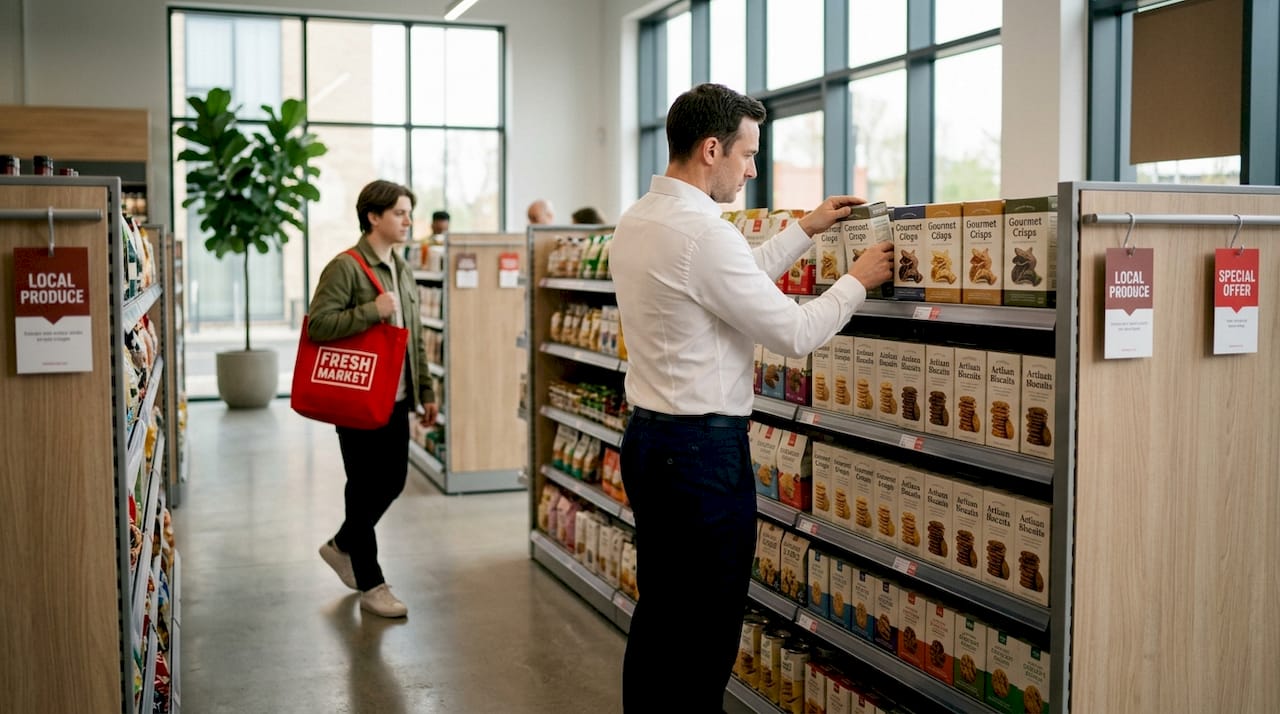
Slatwall panels deserve more credit than they typically receive. Because they accept interchangeable fittings, a single panel can display hanging products one week and shelved products the next. For small retailers whose stock mix changes seasonally, this flexibility is genuinely useful.
Pro Tip: Position your spinner racks near the checkout or entrance. Shoppers who are waiting or just entering are in a browsing mindset, and a well-stocked spinner with low-cost impulse items can add meaningful revenue without consuming much floor space.
Tiered stands work particularly well for products where visual comparison matters. Cosmetics, for example, benefit from being arranged in steps so the customer can see the full colour range at a glance. Dump bins, often overlooked, are highly effective for clearance events or loose seasonal items where the “rummage” experience itself is part of the appeal.
Fixtures, planograms, and visual merchandising
A fixture without a plan is just furniture. The real power of floor fixtures comes when they are integrated into a planogram, which is a visual map specifying exactly which product goes where on each fixture.
Planograms visually map SKU placement on fixtures, specifying exact product positions, facings, and shelving dimensions. For a store manager, this means every fixture becomes part of a coordinated system rather than a collection of individual decisions.
A typical planogram reset follows this sequence:
- Clean and clear the fixture completely
- Adjust fixture components: shelf heights, hook positions, dividers
- Place products according to the planogram diagram
- Verify SKU numbers against the plan to catch any mix-ups before the shop opens
That last step matters more than most people realise. Checking SKU codes and fixture dimensions physically reduces misplacements and keeps your shelves aligned with what shoppers expect to find. A customer who cannot locate a regular purchase will often leave without buying it.
“A well-executed planogram is the operational bridge between category strategy and shop floor execution, ensuring consistent product placement across locations.” — Retail Merchandising Insights
For small retailers managing a single location, planograms might feel like overkill. They are not. Even a simple hand-drawn diagram of which products sit at which height on your gondola will improve consistency and make restocking faster for any member of staff.
How to choose the right fixtures for your store
Selecting the right fixtures comes down to four things: your products, your customers, your space, and your budget.
Start with your products. Heavy items need fixtures with a higher load rating and lower shelf positions. Small, packaged goods work well on pegboard or slatwall with hooks. Apparel needs hanging rails. Fragile items benefit from enclosed acrylic or glass-fronted displays. Getting this wrong is costly, both in damaged stock and in fixtures that need replacing.
Your customers matter just as much. Think about how they shop. Do they browse slowly and compare? Tiered stands and open shelving encourage this. Do they come in knowing exactly what they want? Clear, logical gondola runs with good signage serve them better. Families with pushchairs need wider aisles, which affects how densely you can position fixtures.
When comparing floor displays to counter displays, the differences are significant:
- Floor displays offer higher product capacity, stronger visual impact from a distance, and more space for promotional messaging. They suit high-traffic areas and multi-SKU campaigns.
- Counter displays are compact, positioned at point of purchase, and work best for small, lightweight impulse items where the buying decision happens in the final moment before payment.
Physical attributes to evaluate before purchasing any fixture include height relative to your ceiling and sightlines, durability for daily customer handling, accessibility for all shoppers, and whether the fixture offers any branded surface area for your own signage or graphics.
Pro Tip: Avoid the temptation to fill every inch of floor space with fixtures. Overcrowded stores feel stressful, and shoppers leave faster. A slightly sparser layout with well-chosen fixtures consistently outperforms a cramped one.
A common pitfall is buying fixtures based on price alone. A cheap unit that wobbles, rusts, or cannot hold your product weight will cost you more in the long run than a quality fixture bought once.
Practical ways to get more from your fixtures
Once your fixtures are in place, how you use them determines whether they work for you or against you.
Eye-level placement is your most valuable real estate. Eye-level placement creates up to 35% more sales than bottom shelves, so your highest-margin or fastest-moving products belong at approximately 1.2 to 1.5 metres from the floor. Reserve lower levels for bulkier items or products with loyal customers who will seek them out regardless.
Other practical strategies worth applying:
- Use fixture groupings to encourage cross-selling. Place complementary products on adjacent fixtures, such as coffee next to mugs, or notebooks next to pens.
- Rotate products regularly. A fixture that looks the same for months stops registering with regular customers. Small changes, even just swapping which product faces forward, create a sense of freshness.
- Use the fixture itself as a branding surface. Floor displays provide more space for branding, organising shelving, and promotional messaging, so add header cards, shelf talkers, or branded panels where the fixture allows.
- Check fixtures weekly for damage, missing hooks, or empty facings. A half-empty fixture signals neglect and reduces purchase likelihood.
- Position your most impactful fixtures along the natural customer path, typically the perimeter and main aisle, where foot traffic is highest.
The fixture itself does not sell anything. What it does is create the conditions for a sale. Your job is to keep those conditions as good as possible.
My honest take on fixtures and small retail
I’ve worked with enough small retail businesses to know that fixtures are consistently the most underestimated variable in store performance. Owners will spend weeks choosing paint colours and hours on social media, then buy the cheapest gondola they can find and wonder why the shop feels flat.
What I’ve found is that even modest changes to fixture choice and positioning can shift shopper behaviour in measurable ways. Moving a tiered stand from a side wall to the end of a main aisle, for example, can double the number of customers who interact with it. That is not a small thing.
My contrarian view is this: you do not need a large budget to get fixture strategy right. You need curiosity and a willingness to test. Spend an hour watching how customers move through your store. Notice where they slow down, where they stop, and where they walk straight past. Your fixtures should be where the pauses are, not where the gaps are.
The retailers I’ve seen get the most from their floor space are the ones who treat fixtures as part of their sales team, not as furniture.
— John
Find the right fixtures with Directshopfittings
If this guide has given you a clearer picture of what your store needs, the next step is finding fixtures that actually match those needs.
Directshopfittings carries an extensive range of retail equipment supplies suited to everything from small boutiques to larger retail chains. Their stock covers gondolas, slatwall systems, display stands, pegboard solutions, and much more, with strong manufacturer relationships that allow them to source items that are genuinely hard to find elsewhere. If you have a specific fixture requirement or an unusual space to work with, their team is known for responsive, practical support that saves you time and money. Explore their range and see what fits your store.
FAQ
What are retail floor fixtures?
Retail floor fixtures are freestanding or wall-mounted structures used on the sales floor to hold and display products in ways that encourage shoppers to browse, compare, and buy. They differ from back-stock shelving in that they are designed specifically to influence shopper behaviour.
What are the most common types of retail fixtures?
The most common types include gondolas, endcaps, slatwall panels, pegboard hooks, spinner racks, tiered stands, and dump bins. Each type serves a different merchandising purpose and suits different product categories.
How do I choose the right retail fixtures for my shop?
Consider your product type, weight, and size first, then factor in your customer flow, available floor space, and budget. Floor displays suit high-volume or promotional products, while counter displays work best for small impulse items near the till.
What is a planogram and how does it relate to fixtures?
A planogram is a visual diagram that maps exactly which products go where on each fixture, including shelf heights and facings. Linking your fixtures to a planogram reduces restocking errors and keeps your store layout consistent.
Does eye-level placement on fixtures really affect sales?
Yes. Research shows that eye-level placement on fixtures can generate up to 35% more sales compared to products placed on lower shelves, making it the most valuable position on any floor fixture.