

TL;DR:
- Choosing retail equipment suppliers involves evaluating total cost, quality, delivery reliability, and technology compatibility through a structured process.
- Using tools like scorecards, site visits, and clear contracts helps mitigate risks and ensures supplier collaboration aligns with store needs.
Retail equipment supplier selection is the process of objectively evaluating potential vendors against criteria including cost, quality, delivery reliability, and compatibility with your store’s existing systems. For small to medium-sized retailers, getting this process right determines whether your shopfitting investment pays off or quietly drains your margins through downtime, poor service, and hidden charges. A structured approach, using tools like Requests for Proposals (RFPs), supplier audits, and total cost evaluation, separates the suppliers worth partnering with from those who simply offer the lowest quote.
What key criteria should you consider when choosing a retail equipment supplier?

Effective retail vendor evaluation starts with six core criteria. Ivalua’s 2026 guidance confirms that supplier experience, product quality, total landed cost, and delivery reliability are the non-negotiable pillars of any sound evaluation. Miss one and you risk a supplier relationship that looks good on paper but fails in practice.
Here is what to assess for each criterion:
- Experience and track record. How long has the supplier served retail businesses of your size? Ask for case studies from comparable clients, whether boutique fashion stores or multi-site convenience chains.
- Product quality and certifications. Certifications matter, but audit performance and corrective action evidence matter more. A supplier with a quality certificate but no documented internal controls is a risk.
- Total cost, not unit price. Factor in shipping, installation, and ongoing maintenance. Hidden fees like shipping and installation can add 10 to 20% to your total expenditure beyond the sticker price. That figure changes every budget calculation.
- Delivery timelines and reliability. Late deliveries during a store refit cost far more than the delay itself. Request historical on-time delivery rates and ask how the supplier handles shortfalls.
- Warranty, serviceability, and support. Confirm the supplier is an authorised dealer. Grey-market purchases can void warranty coverage entirely, transferring the cost of any future repair directly to you.
- Scalability. If you plan to open a second or third location, your supplier must be able to grow with you. Confirm minimum order quantities, lead times for bulk orders, and whether they can support consistent equipment specifications across sites.
Pro Tip: Build a simple weighted scorecard before you contact any supplier. Assign each criterion a percentage weight based on your priorities, then score every candidate consistently. This removes gut-feel bias from the final decision.
How can you structure a reliable supplier selection process?
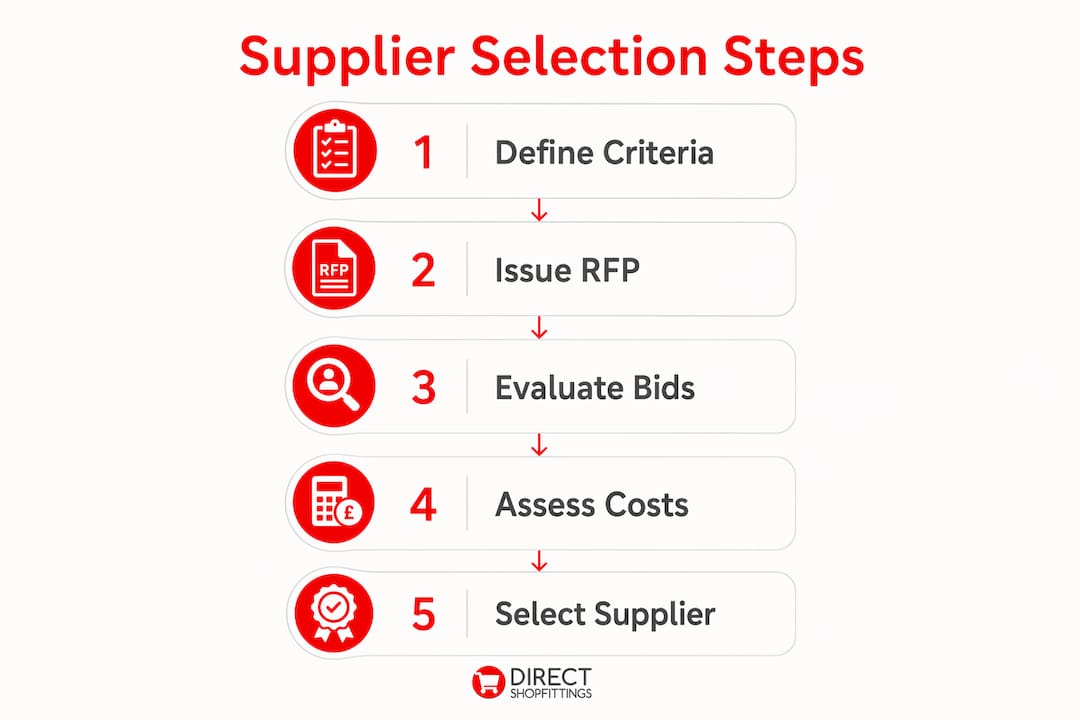
SafetyCulture recommends a phased approach to supplier selection: need identification, supplier listing, shortlisting, meetings, audits, and negotiation using weighted criteria. This structure reduces unknowns and makes objective comparison possible. Here is how to apply it to retail equipment sourcing.
- Define your requirements precisely. List every category of equipment you need, from gondola shelving and display fixtures to POS terminals and storage racking. Specify quantities, dimensions, finish standards, and any compliance requirements. Vague briefs produce vague quotes.
- Research and list potential suppliers. Use trade directories, industry events, and peer recommendations to build an initial list of eight to twelve candidates. DirectShopfittings, for example, operates an extensive supplier network specifically designed to source hard-to-find shopfitting items efficiently.
- Issue an RFI, RFP, or RFQ. A Request for Information (RFI) works for early-stage market research. A Request for Proposal (RFP) suits complex or high-value purchases where you want suppliers to propose solutions. A Request for Quotation (RFQ) is appropriate when your specification is fixed and you simply need competitive pricing.
- Evaluate proposals against your weighted scorecard. Score each response consistently. Do not let a low unit price override poor scores on delivery reliability or warranty terms.
- Conduct supplier meetings, demos, and audits. For significant purchases, visit the supplier’s warehouse or showroom. Seeing stock levels, handling quality, and operational processes in person reveals far more than any brochure.
- Negotiate contracts with clear terms. Focus on payment schedules, delivery windows, return policies, and service level agreements (SLAs). Vague contract language is where supplier relationships break down.
Pro Tip: When issuing an RFP for retail equipment, include a sample scenario: “We need 40 units delivered to two locations within 10 working days.” The supplier’s response to a concrete scenario tells you more about their capability than any self-reported delivery statistic.
What are the hidden costs and budget considerations when sourcing retail equipment?
The sticker price of retail equipment is rarely the final price. A thorough retail supply chain guide must account for every cost layer between the supplier’s warehouse and your shop floor.
| Cost category | What to watch for |
|---|---|
| Initial purchase price | Unit cost, minimum order quantities, volume discounts |
| Delivery and installation | Freight charges, white-glove delivery fees, installation labour |
| Warranty and servicing | Callout fees, parts costs, response time SLAs |
| Software and subscriptions | POS software licences, firmware update fees, cloud service charges |
| Downtime and lost sales | Indirect cost of equipment failure during trading hours |
Beyond the table above, two cost traps catch retailers most often. The first is buying outside authorised channels to save money upfront. As LegalClarity notes, warranty risk transfers when you purchase from non-authorised sources, meaning a single repair bill can wipe out the initial saving. The second trap is underestimating recurring costs. POS systems, for instance, often carry annual software subscription fees, mandatory firmware updates, and peripheral replacement cycles that never appeared in the original quote.
Focusing solely on unit price leads to hidden costs through lack of reliability and service. The smarter approach is to calculate a three-year total cost of ownership for any significant equipment category before committing to a supplier. This includes purchase price, delivery, installation, expected maintenance, and the estimated cost of any downtime. For guidance on understanding the full cost of retail floor fixtures, the calculation follows the same logic.
How do you evaluate ongoing reliability and service from your supplier?
Selecting a supplier is not a one-time event. The quality of the relationship after the first order determines whether your store operations stay consistent or suffer repeated disruptions. Building strong supplier relationships improves the reliability of supply for essential equipment and reduces the risk of stockouts at critical moments.
The following practices build and protect that reliability:
- Set measurable SLAs from day one. Define acceptable response times for queries, maximum delivery lead times, and escalation procedures for urgent orders. Converting responsiveness metrics into contract clauses protects you from vague promises that evaporate when problems arise.
- Schedule regular performance reviews. Quarterly reviews with key suppliers allow you to address issues before they become crises. Track on-time delivery rates, order accuracy, and response times against the agreed SLAs.
- Conduct periodic supplier audits. For high-value or high-frequency suppliers, an annual audit of their processes and stock capacity confirms they can still meet your needs as your business grows.
- Maintain a spares and contingency plan. For critical equipment like POS terminals, hold a small pool of spare units. Spares pools and swap models reduce downtime and support consistent performance across multi-site operations.
Pro Tip: Ask every shortlisted supplier how they handle a situation where they cannot fulfil your order on time. Their answer reveals more about their service culture than any reference check.
Open communication with suppliers helps manage delays, order changes, and payment schedules effectively. Treat your best suppliers as partners rather than vendors, and they will prioritise your account when stock is tight.
How does technology compatibility affect your supplier choice?
For any retailer investing in POS hardware, payment terminals, or networked display systems, technology compatibility is a selection criterion that carries the same weight as price. POS hardware suppliers must be evaluated for scalability, deployment consistency, peripheral compatibility, serviceability, and lifecycle control. Choosing a supplier whose hardware conflicts with your existing software stack creates integration costs that dwarf any initial saving.
| Compatibility factor | Single-site retailer | Multi-site retailer |
|---|---|---|
| POS software integration | Confirm compatibility with current system | Require standardised hardware spec across all sites |
| Peripheral support | Check receipt printer and scanner compatibility | Mandate consistent peripheral models for easier servicing |
| Firmware and version control | Confirm update process and frequency | Require version-locked firmware for rollout consistency |
| Acceptance testing | Test one unit before full order | Formal acceptance test protocol for every batch |
Version control deserves particular attention. A supplier who ships mixed firmware versions across a single order creates support headaches that are entirely avoidable. Require your supplier to confirm the firmware version on every unit before despatch, and test a sample unit against your live system before accepting a full delivery. For retailers evaluating POS payment solutions, this compatibility check is non-negotiable.
Standardisation across sites also reduces training time, simplifies maintenance contracts, and makes it far easier to negotiate volume pricing with a single supplier for future orders.
Key takeaways
Selecting the right retail equipment supplier requires evaluating total cost, quality evidence, delivery reliability, and technology compatibility through a structured, staged process.
| Point | Details |
|---|---|
| Use a weighted scorecard | Score every supplier against the same criteria to remove bias from the final decision. |
| Calculate total cost of ownership | Add delivery, installation, maintenance, and downtime costs before comparing suppliers. |
| Verify authorised dealer status | Buying outside authorised channels risks voiding warranty coverage entirely. |
| Set contractual SLAs | Convert responsiveness and delivery promises into measurable contract terms from day one. |
| Plan for technology compatibility | Confirm POS hardware and peripheral compatibility before committing to any supplier. |
Why the cheapest quote is rarely the right answer
I have reviewed enough retail equipment purchases to say with confidence that the most common mistake small retailers make is treating supplier selection as a price comparison exercise. It is not. It is a risk management exercise.
The retailers who regret their supplier choices almost always followed the same path: they took the lowest quote, skipped the audit, and discovered six months later that the supplier could not restock quickly, the warranty was invalid because the goods came through a grey-market channel, or the POS hardware was incompatible with their payment processor. Each of those problems costs far more to fix than the original saving was worth.
What actually works is a staged process with a clear scorecard, at least one in-person or video audit of the supplier’s operation, and contract terms that spell out exactly what happens when something goes wrong. The retailers I have seen build genuinely reliable supply chains treat their best suppliers as long-term partners. They share forecasts, pay on time, and give feedback. In return, they get priority fulfilment when stock is tight and faster resolution when problems arise.
The retail shelving buyers guide from DirectShopfittings reflects this philosophy well: product quality and supplier reliability are presented alongside price, not instead of it. That balance is exactly right.
— Lee
Source your retail equipment with confidence through DirectShopfittings
DirectShopfittings supplies an extensive range of shopfitting supplies and retail equipment to independent retailers and multi-site chains across the UK. From gondola shelving and display fixtures to POS peripherals and storage solutions, the product range covers the full scope of a retail equipment sourcing checklist. What sets DirectShopfittings apart is its supplier network, built specifically to source hard-to-find items efficiently and deliver them quickly. If you are working through a supplier evaluation and need reliable, competitively priced equipment with expert support behind it, DirectShopfittings is the place to start. Explore the full range and speak to the team about your store’s specific requirements.
FAQ
What is a retail equipment supplier selection guide?
A retail equipment supplier selection guide is a structured framework for evaluating and choosing vendors based on criteria including cost, quality, delivery reliability, and technology compatibility. It helps retailers make objective decisions rather than defaulting to the lowest price.
How many suppliers should I shortlist before making a decision?
Start with eight to twelve candidates from initial research, then shortlist three to five for detailed evaluation. SafetyCulture’s phased approach recommends progressing through meetings and audits before final selection.
What hidden costs should I watch for when buying retail equipment?
Shipping and installation fees can add 10 to 20% to your total spend beyond the unit price. Also account for software subscriptions, maintenance callout fees, and the indirect cost of equipment downtime during trading hours.
Does buying from a non-authorised supplier affect my warranty?
Yes. Warranty coverage is voided when goods are purchased through non-authorised channels, meaning any repair or replacement cost falls entirely on you. Always confirm authorised dealer status before purchasing.
How do I assess a supplier’s reliability before placing a large order?
Request historical on-time delivery rates, conduct a site visit or video audit, and ask how they handle fulfilment shortfalls. For POS hardware, test a sample unit against your live system before accepting a full batch delivery.