
Table of Contents
- Key takeaways
- Gondola shelving setup: what you need first
- How to assemble and install gondola shelving
- Common mistakes and how to avoid them
- Layout ideas for small retail spaces
- My honest take on small shop shelving
- Get your shelving sorted with Directshopfittings
- FAQ
Key takeaways
| Point | Details |
|---|---|
| Measure before you buy | Accurate floor measurements prevent costly mismatches between shelving units and available space. |
| Adjustable shelves add flexibility | Units with adjustable shelving accommodate products of different heights without wasted vertical space. |
| Assembly sequence matters | Building the base and uprights correctly before adding shelves prevents instability and rework. |
| Corner and centre units work together | Combining centre gondola runs with corner units turns every part of the floor into productive retail space. |
| Layout affects customer behaviour | Aisle width and gondola placement directly influence how long customers browse and how much they buy. |
Gondola shelving setup: what you need first
Before you touch a single upright post, preparation separates a smooth installation from a frustrating one. Proper measurement is the single most important step. Walk your shop floor with a tape measure and note every obstacle: doorways, service counters, electrical sockets, and fire exit routes. Sketch a rough floor plan, even on paper. You need to know your total floor area, ceiling height, and the width of your intended aisles before ordering anything.
Choosing the right gondola unit
Not all gondola shelving is built the same. For small retail environments, you want units that are compact yet roomy, meaning narrower bays (typically 900mm to 1000mm wide) with heights between 1200mm and 1800mm. Taller units maximise vertical storage but can make a small shop feel like a maze. A height of around 1500mm tends to strike the right balance for most independent retailers. Here is what you need to gather before assembly begins:
- Tape measure and spirit level
- Rubber mallet (for fitting shelf clips without damaging the uprights)
- Adjustable spanner and screwdriver set
- Wall anchor kit if you plan to fix any perimeter units to the wall
- A floor plan sketch with dimensions marked
- Gondola base, upright posts, back panels, shelf brackets, and shelves
Gondola types suited to small shops
| Unit type | Best use | Typical width |
|---|---|---|
| Single-sided wall gondola | Perimeter display along walls | 300mm to 450mm deep |
| Double-sided centre gondola | Creating aisles in the shop floor | 600mm to 900mm deep |
| Corner gondola unit | Filling corner spaces efficiently | Varies by angle |
| End cap unit | Promotional display at aisle ends | 600mm to 900mm wide |
Adjustable shelves are worth paying a little more for. They let you reconfigure the unit as your product range changes, rather than buying new shelving every time you take on a taller product line. Pro Tip: Buy one extra shelf per unit when you place your initial order. Shelf clips are the most commonly lost component during assembly and reconfiguration, and having spares on hand saves a trip back to the supplier. 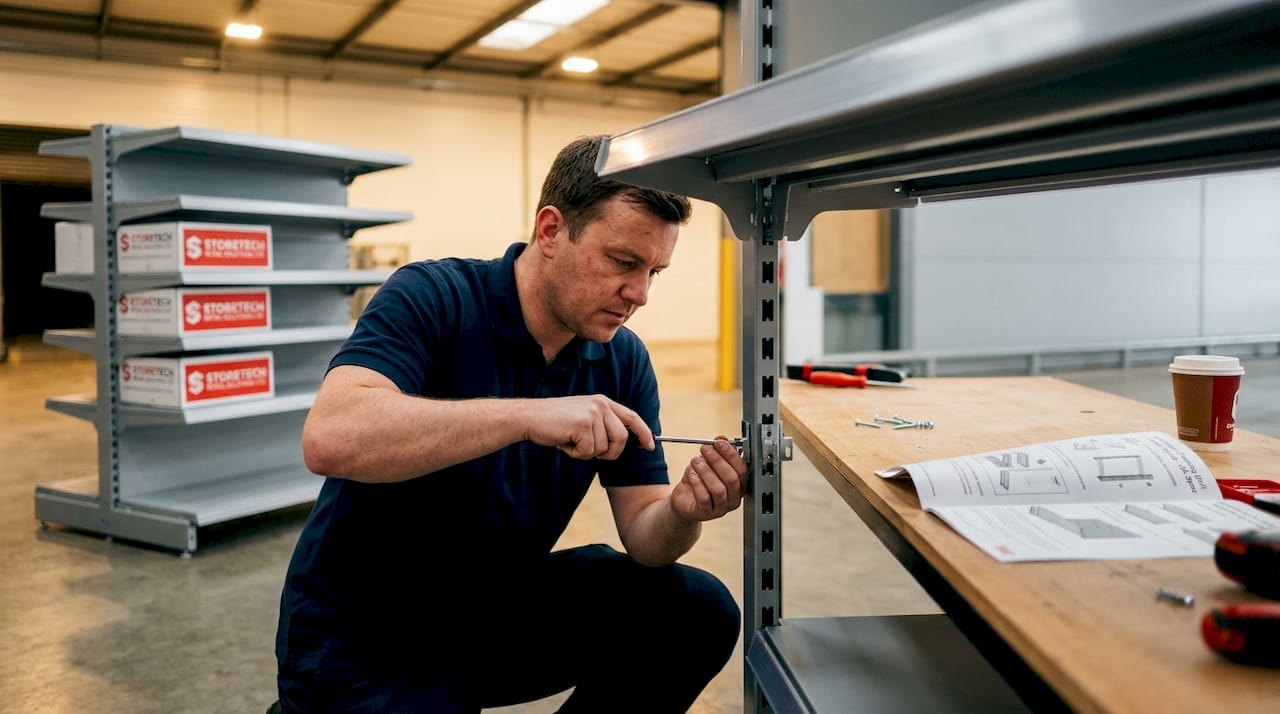
How to assemble and install gondola shelving
Assembly is straightforward once you understand the sequence. Rushing it, or skipping steps, is where most problems begin. DIY gondola assembly is entirely achievable for a small shop owner, but attention to each stage is non-negotiable.
- Clear and mark the floor. Use masking tape to mark the exact footprint of each gondola run on the floor before you open a single box. This lets you check aisle widths and confirm the layout works in practice, not just on paper.
- Assemble the base first. Lay the base frame flat and connect the upright posts according to the manufacturer’s instructions. Hand-tighten all bolts initially. Do not fully tighten until the whole frame is square.
- Check for level. Stand the base upright and use your spirit level on both the front and side faces. Gondola shelving on an uneven floor will wobble under load. Use the adjustable feet (most units have them) to compensate for any floor irregularities.
- Attach the back panels. Back panels add rigidity to the whole unit. Clip or bolt them into the uprights before adding any shelves. Skipping this step is a common mistake that leaves the unit flexible and unsafe under heavy stock.
- Insert shelf brackets and shelves. Clip the brackets into the upright slots at your chosen heights. Place shelves on the brackets and press down firmly until you hear the click. Give each shelf a firm push to confirm it is locked in.
- Fully tighten all bolts. Once the unit is level and square, go back and tighten every bolt properly. Work from the base upwards.
- Load shelves from the bottom up. Heavier products go on lower shelves. This keeps the centre of gravity low and the unit stable.
- Repeat for each unit, then connect runs. If you are creating a gondola run (multiple units joined end to end), connect them using the joining clips or bolts supplied. A connected run is significantly more stable than individual freestanding units.
Pro Tip: Never move a fully assembled and stocked gondola unit. Moving pre-assembled shelving risks damaging the base joints and compromising the whole structure. Disassemble, move, and reassemble instead.
Common mistakes and how to avoid them
Even experienced shop fitters make errors on small-shop installations. The constraints of a tight floor plan amplify every mistake.
- Ignoring aisle width. A minimum aisle width of 900mm is the accepted standard for comfortable customer movement. Go narrower and customers will avoid the aisle entirely, especially with pushchairs or mobility aids.
- Overloading upper shelves. Placing heavy stock high up raises the centre of gravity and increases tipping risk. Follow the bottom-heavy loading rule without exception.
- Skipping the spirit level. A gondola unit that is even slightly off-level will rock under load. This is both a safety hazard and a deterrent to customers who notice the instability.
- Placing units too close to the entrance. The first two metres inside your door should remain clear. Customers need a moment to adjust to the space before they start browsing.
- Buying non-adjustable shelving. Fixed-height shelves lock you into a product range. Your stock will change. Your shelving needs to change with it.
“The layout of your shop floor is not a one-time decision. Treat it as a living system that you review every season, and your gondola units will always be working for you rather than against you.”
Troubleshooting is usually straightforward. If a shelf feels loose, check that both bracket clips are fully engaged in the upright slots. If the whole unit rocks, re-check the adjustable feet and the floor level. If back panels bow outward, the connecting bolts between uprights may need tightening.
Layout ideas for small retail spaces
This is where the real gains are made. Getting the assembly right is the foundation. Getting the layout right is what drives sales. 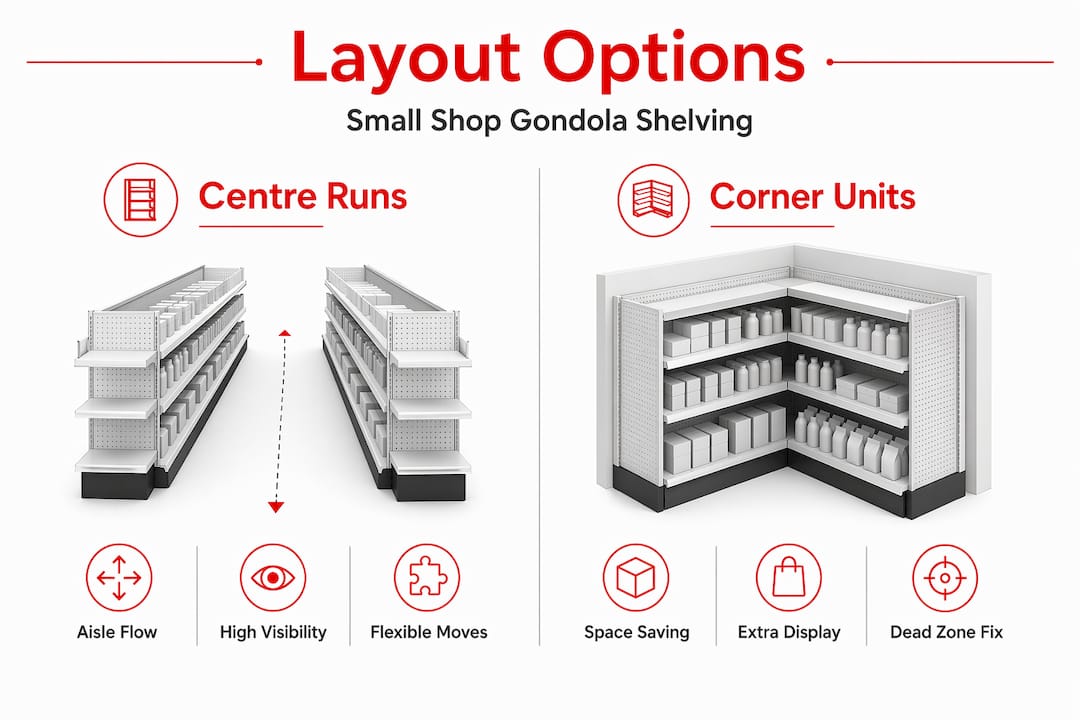 Freestanding gondola units can be placed anywhere on your shop floor, which gives you genuine flexibility to experiment. Most successful small shops use a combination of three placement strategies.
Centre runs create natural aisles
Positioning double-sided gondola units in the centre of your floor creates defined aisles that guide customers through the shop. Centre gondola racks improve navigation and make it easier for customers to find products without asking for help. In a shop of 30 to 50 square metres, one or two centre runs are usually sufficient.
Corner units recover dead space
Corners are the most wasted areas in small shops. Corner gondola racks turn those dead zones into productive display space. They work particularly well for promotional items, seasonal stock, or products you want to push on impulse.
Comparing layout approaches
| Layout style | Pros | Best for |
|---|---|---|
| Perimeter-only shelving | Keeps floor open, easy to clean | Very small shops under 20 sqm |
| Centre runs with perimeter | Maximises product capacity | 30 to 80 sqm shops |
| Grid layout | High product density | Convenience stores, off-licences |
| Angled gondola placement | Creates visual interest | Boutiques, gift shops |
A few additional display principles worth applying:
- Place your best-selling products at eye level (roughly 1200mm to 1600mm from the floor).
- Use end caps on gondola runs for promotional or high-margin products. Customers always see the ends of aisles.
- Group related products together. A customer buying coffee should immediately see filters, mugs, and sugar nearby.
- Keep the bottom shelf at least 150mm off the floor. This makes cleaning easier and prevents the shop from looking cluttered at ground level.
My honest take on small shop shelving
I’ve seen a lot of small shop owners spend their budget on the shelving itself and then treat the layout as an afterthought. That is the wrong order of priorities. In my experience, a modest set of well-positioned gondola units will outsell an expensive, poorly arranged shopfit every time. What I’ve found most underestimated is the impact of aisle width. Owners consistently try to squeeze in one more gondola run, reducing the aisle to 700mm or less. Customers notice. They feel uncomfortable, they browse less, and they leave sooner. The lost sales from that cramped aisle cost far more than the extra unit earns. The other thing I’d push back on is the assumption that small shops need small shelving. A 1500mm to 1800mm gondola unit in a compact shop actually makes the space feel more professional and well-stocked, not more crowded. Height draws the eye upward and creates a sense of abundance that low shelving simply cannot replicate. My practical shortcut: set up your gondola runs empty and walk the aisles yourself. Then ask someone who has never been in the shop to do the same. Watch where they pause, where they hesitate, and where they feel blocked. That observation session will tell you more about your layout than any floor plan diagram.
— John
Get your shelving sorted with Directshopfittings
If you are ready to move from planning to purchasing, Directshopfittings has the stock and the expertise to make it straightforward.  Directshopfittings carries an extensive range of gondola shelving units suited to shops of every size, from single-sided wall units to full centre runs and corner displays. Their network of manufacturers means they can source hard-to-find sizes and configurations that most suppliers simply do not stock. Fast delivery and genuinely responsive customer service mean you are not left waiting when your refit is on a schedule. Browse the full range of gondola shelving options and find the right fit for your shop floor today.
FAQ
What is gondola shelving?
Gondola shelving is a freestanding, double-sided shelving system widely used in retail environments. Units consist of a base, upright posts, back panels, and adjustable shelves that can be configured to suit different product types and store layouts.
How much space do I need between gondola runs?
A minimum aisle width of 900mm is recommended for comfortable customer movement. Wider aisles of 1100mm to 1200mm are preferable if your customer base includes families with pushchairs or customers with mobility aids.
Can I assemble gondola shelving myself?
Yes. Most gondola shelving units are designed for straightforward self-assembly using basic tools. Following the correct sequence, base and uprights before shelves, and checking for level at each stage, is the key to a stable result.
How do I stop gondola shelves from wobbling?
Check that the adjustable feet are properly set to compensate for any floor unevenness, confirm all back panels are fitted and bolts are fully tightened, and verify that shelf brackets are fully clipped into the upright slots on both sides.
What height gondola shelving suits a small shop?
Units between 1500mm and 1800mm tall work well for most small retail shops. This height maximises vertical storage without blocking sightlines across the shop floor, which helps customers orientate themselves and feel comfortable browsing.