

TL;DR:
- Retail fixtures are hardware structures used to display and organize products in stores, distinct from the actual merchandising displays built on them. Choosing the correct fixture types, such as gondolas, end caps, or slatwalls, influences product visibility and sales performance significantly. Proper material and placement decisions enhance durability, customer experience, and overall store effectiveness.
Retail display fixtures are the physical hardware structures used to organise, hold, and present merchandise in a store environment. They are distinct from displays: fixtures are the hardware; displays are the merchandising presentations built on top of them. Gondolas, slatwalls, mannequins, and point-of-purchase (POP) units are the four most common fixture categories found across British retail. Getting retail display fixture types explained correctly matters because the wrong fixture choice directly reduces product visibility, disrupts customer flow, and costs sales. POP displays influence about 16% of unplanned retail purchases, which shows how much physical hardware shapes buying behaviour before a customer even consciously decides to buy.
What are the main types of retail display fixtures?
Retail shelving types and floor fixtures form the backbone of any store layout. Each fixture category serves a specific merchandising function, and choosing the wrong one for a product category creates friction for shoppers.
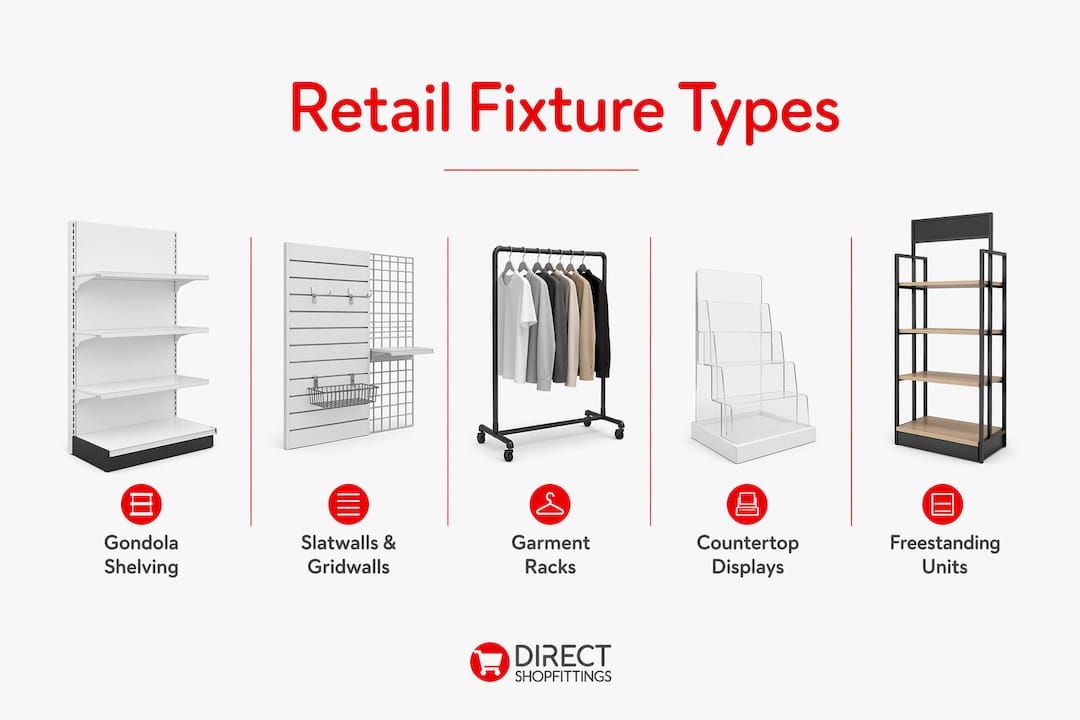
Gondola shelving is the most-used fixture in supermarkets, pharmacies, electronics retailers, and value-fashion stores. Gondolas organise SKUs into aisles and categories, making them the default choice for high-volume, self-service retail. They are adjustable, double-sided, and built to carry significant product weight.
End caps sit at the end of gondola runs and offer the highest-visibility real estate after store entrances. Brands regularly pay slotting fees to secure end cap positions because of their proven impact on promotions and new product launches. A well-merchandised end cap can outsell mid-aisle positions by a considerable margin.
Slatwalls and gridwalls are wall-mounted panel systems that accept interchangeable hooks, shelves, and brackets. They suit apparel, accessories, and gift retailers where product ranges change frequently. The modular nature of slatwalls means you can reconfigure a wall display in under an hour without specialist tools.
Countertop displays sit on service counters or checkout points and are purpose-built for small, high-margin products. Confectionery, phone accessories, and cosmetics all perform well in countertop units because they sit directly in the customer’s eyeline at the point of decision.
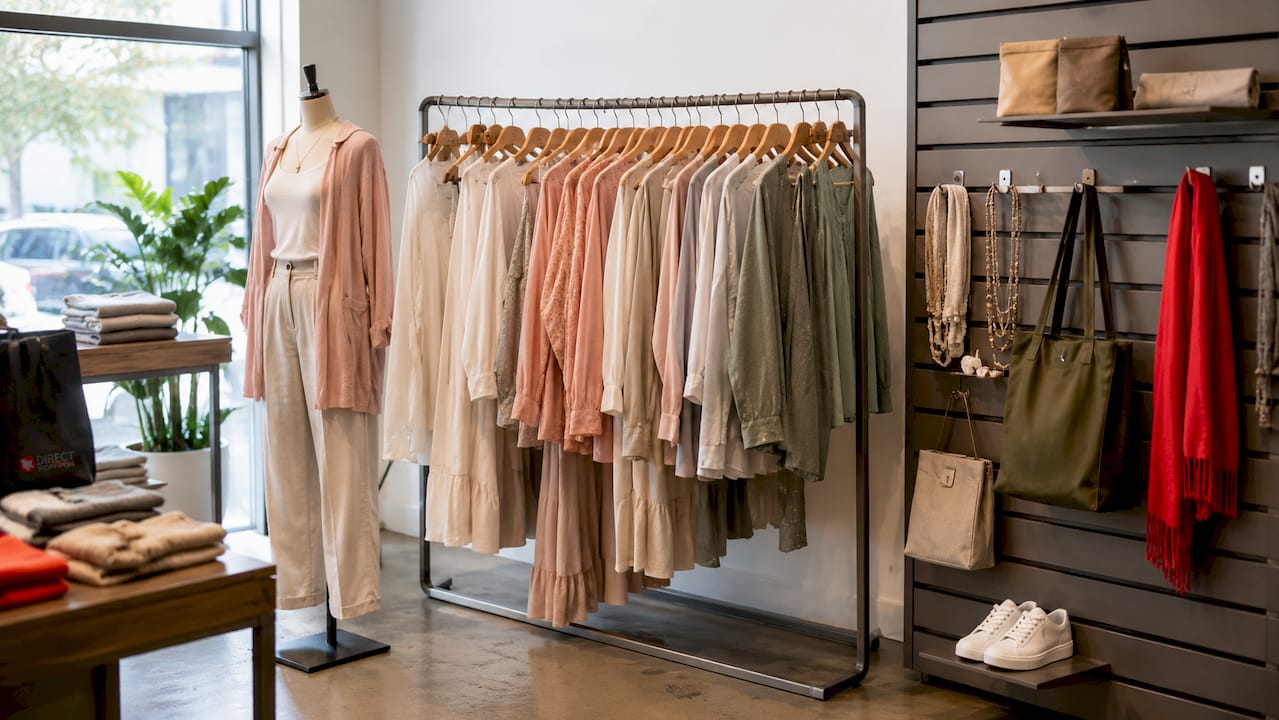
Garment racks and mannequins are the primary fixtures for fashion retail. Garment racks present volume; mannequins present styled outfits and drive attachment purchases. A mannequin wearing a complete look consistently increases the average transaction value in clothing stores.
Display cases and cabinets protect high-value or fragile products such as jewellery, watches, and electronics. Locked glass cases signal premium positioning and reduce shrinkage simultaneously. For a detailed breakdown of cabinet options, the retail display cabinet guide from DirectShopfittings covers the main formats in depth.
Freestanding display units (FSDUs) are self-contained, floor-standing structures used for branded promotions. They are common in grocery and pharmacy environments where brands want a dedicated footprint outside the main shelving run.
| Fixture type | Ideal use | Typical footprint |
|---|---|---|
| Gondola shelving | Supermarkets, pharmacies, electronics | Large floor area, aisle-based |
| End cap | Promotions, new launches | End of gondola run |
| Slat wall / gridwall | Apparel, accessories, gifts | Wall-mounted, minimal floor space |
| Countertop display | Impulse buys, small accessories | Counter surface only |
| Garment rack | Fashion, clothing | Mid-floor or perimeter |
| Display case | Jewellery, watches, electronics | Counter or floor-standing |
| Freestanding display unit | Branded promotions | Standalone floor position |
Pro Tip: Match fixture height to product accessibility. Eye-level shelving on gondolas and slatwalls sells fastest. Reserve lower shelves for bulk or heavy items and upper shelves for secondary stock.
How do materials and design choices affect retail fixtures?
Material selection is both strategic and aesthetic, and the wrong choice undermines both durability and brand perception. The three dominant materials across retail fixture options are metal, wood, and acrylic, and each serves a different retail environment.
- Metal is the preferred material for high-traffic, load-bearing fixtures. Steel gondolas and chrome garment racks withstand daily restocking, heavy product loads, and years of continuous use. Metal suits supermarkets, hardware stores, and any environment where durability outweighs aesthetics.
- Wood delivers a premium, tactile feel that metal cannot replicate. Boutique fashion stores, homeware retailers, and independent gift shops use wooden fixtures to create warmth and signal quality. The trade-off is weight and susceptibility to moisture damage in poorly ventilated spaces.
- Acrylic maximises product visibility and suits luxury or cosmetics retail where the product itself is the hero. Clear acrylic display cases and risers let shoppers see items from multiple angles without handling them. Acrylic scratches more easily than metal or wood, so it suits lower-traffic display positions.
Fixture lifespan varies significantly by material and intended use. Temporary POP displays last less than 3 months; semi-permanent fixtures last 3–12 months; permanent fixtures are designed for multi-year use. This distinction matters for budgeting. A retailer running quarterly promotions needs a different investment calculation than one fitting out a permanent store.
Value engineering at the design stage improves return on investment by reducing logistics costs, simplifying installation, and extending fixture life. Retailers who involve their supplier early in the specification process consistently achieve better outcomes than those who treat fixtures as a last-minute procurement decision.
Pro Tip: Before committing to a material, test a single unit in-store for four weeks. Assess wear, staff handling, and customer interaction before ordering at scale.
Digital and interactive displays are a growing fixture category that combines physical hardware with screens or sensors. They are most common in electronics, beauty, and fashion retail, where product education drives conversion. The hardware investment is higher, but engagement rates justify the cost in the right category.
What role does fixture placement play in shopper experience?
Fixture placement determines whether a store feels intuitive or frustrating to navigate. Effective fixture placement follows customer traffic flow to avoid bottlenecks and support natural shopper movement through the space. Poor placement creates dead zones where products go unseen regardless of how well they are merchandised.
The following placement principles apply across store formats:
- Align fixtures with the natural traffic path. Most shoppers in the UK turn right upon entering a store. Place your highest-margin or promotional fixtures in that first right-hand zone.
- Maintain clear sightlines. Fixtures taller than 1.5 metres obstruct sightlines across the shop floor. Use tall gondolas on perimeter walls and lower fixtures in the centre of the floor.
- Position POP displays at checkout and high-dwell zones. POP displays influence about 16% of impulse purchases, and that effect is strongest where shoppers pause or queue.
- Use end caps for promotions and new stock. End caps generate disproportionate sales relative to their floor space. Rotate end cap content every two to four weeks to maintain shopper interest.
- Leave adequate aisle width. A minimum of 900mm between fixtures allows comfortable browsing and meets accessibility requirements. Narrow aisles cause shoppers to abandon browsing and leave.
Fixture placement must enhance customer flow and avoid sightline obstruction to maximise sales potential. Retailers who treat placement as a spatial planning exercise, rather than a stocking convenience, consistently see stronger sales per square metre. The retail shelving layout guide from DirectShopfittings provides a practical step-by-step framework for applying these principles in-store.
How to choose the right display fixtures for your store
Choosing the right retail fixture options requires matching hardware to your store format, product category, and operational reality. The following factors determine the correct specification:
- Store size and format. Large-format stores suit gondola runs and wide garment racks. Boutiques and pop-up shops need compact, modular fixtures such as slatwalls, FSDUs, and countertop units that maximise display in limited floor space.
- Product weight and category. Heavy products such as tools, canned goods, or footwear require metal shelving rated for the load. Lightweight accessories and gifts can use acrylic or wooden display options without structural risk.
- Promotional cycle. If your range changes seasonally or monthly, invest in modular fixtures with interchangeable components. Permanent bespoke fixtures are only cost-effective when the product range is stable.
- Budget and ROI horizon. Temporary cardboard POP units cost far less upfront but require replacement within weeks. Metal or wooden permanent fixtures carry a higher initial cost but deliver a lower cost per year of use over time.
- Assembly complexity. Fixtures must be store-ready and easy to assemble to avoid misassembly and staff resistance. A fixture that takes two hours to build correctly will often be built incorrectly or avoided entirely.
Stores use permanent fixtures as a foundation and update graphics and signage for seasonal freshness without replacing the underlying hardware. This approach reduces capital expenditure while keeping the store looking current. For new store owners, the retail store opening equipment guide from DirectShopfittings outlines the essential fixture categories to prioritise from day one.
The difference between a big-box store and a boutique is not just scale. It is the fixture specification. A boutique using gondola shelving designed for a supermarket will feel clinical and impersonal. A large-format store using lightweight acrylic risers will look underpowered and fragile. Matching fixture design to store identity is as important as matching it to product weight.
Key takeaways
The most effective retail display strategy combines permanent fixture infrastructure with regularly updated displays, matched to product category, store format, and customer traffic patterns.
| Point | Details |
|---|---|
| Fixtures vs displays | Fixtures are the hardware; displays are the merchandising built on top. Keep both roles distinct. |
| Gondolas dominate volume retail | Gondola shelving suits supermarkets, pharmacies, and electronics stores for high-SKU merchandising. |
| Material choice drives durability | Metal for heavy use, wood for premium feel, acrylic for visibility in luxury or cosmetics settings. |
| Placement follows traffic flow | Position POP and promotional fixtures where shoppers naturally pause, queue, or turn right on entry. |
| Assembly complexity is a real risk | Choose fixtures that staff can build correctly without specialist tools or lengthy instructions. |
What I have learned from years of watching retailers get fixtures wrong
Retailers consistently underestimate how much their fixture choices communicate to customers before a single product is picked up. Walk into a store where the fixtures are mismatched, overloaded, or clearly designed for a different retail format, and the immediate impression is one of disorder. That impression transfers directly to the products on display.
The most common mistake I see is treating fixtures as a pure cost line rather than a brand asset. A boutique that invests in quality wooden display tables and well-proportioned garment racks will outsell an identical product range presented on tired chrome gondolas. The fixture is the frame. The product is the picture. A poor frame diminishes even a strong picture.
Assembly complexity is the issue that almost nobody talks about until it causes a problem. A fixture that requires a specialist tool or a 45-minute build will be assembled incorrectly by a time-pressured member of staff. Incorrectly assembled fixtures look poor, create safety risks, and undermine the entire merchandising effort. Always ask your supplier for an assembly time estimate before committing to a specification.
The shift towards digital and interactive fixtures is real, but I would caution against adopting them without a clear conversion rationale. A screen on a fixture that does not directly support the purchase decision is a distraction, not an asset. The physical fixture still does the heavy lifting. Digital elements work best when they answer a specific product question the shopper would otherwise need staff assistance to resolve.
My practical advice: start with your traffic flow, choose your permanent fixture infrastructure to match your store identity and product load, then layer in modular and promotional elements that you can rotate without capital expenditure. That sequence produces better results than any other approach I have seen.
— Lee
How DirectShopfittings helps you source the right fixtures
DirectShopfittings supplies an extensive range of retail display fixtures and shopfitting equipment to stores of every size, from independent boutiques to national retail chains. The product range covers gondola shelving, countertop displays, garment racks, display cabinets, POP units, and storage racking, all available with rapid delivery and competitive pricing.
If you are fitting out a new store or refreshing an existing one, the retail floor fixtures guide is a practical starting point for identifying the right hardware for your space. For a broader overview of shopfitting fundamentals, the shopfitting guide for small retailers covers everything from fixture selection to layout planning in plain language. DirectShopfittings also maintains a supplier network that sources hard-to-find items efficiently, saving retailers time and procurement cost on specialist requirements.
FAQ
What are retail display fixtures?
Retail display fixtures are the physical hardware structures used to hold, organise, and present merchandise in a store. They include gondola shelving, slatwalls, garment racks, display cases, countertop units, and freestanding display units.
What is the difference between a fixture and a display?
A fixture is the permanent or semi-permanent hardware structure; a display is the merchandising presentation built on top of it. Stores update displays regularly for seasonal freshness while keeping the underlying fixture infrastructure in place.
Which fixture type is best for impulse purchases?
Countertop displays and POP units positioned at checkout or high-dwell zones are the most effective for impulse purchases. POP displays influence about 16% of unplanned retail purchases, making placement near the point of payment the highest-return position.
How long do retail display fixtures last?
Lifespan depends on material and use. Temporary POP displays last less than 3 months; semi-permanent fixtures last 3–12 months; permanent metal or wooden fixtures are designed for multi-year use with proper maintenance.
How do I choose the right fixture for my store?
Match fixture type to your store format, product weight, promotional cycle, and budget. Prioritise fixtures that are easy to assemble, suited to your product category, and consistent with your store’s brand identity.