
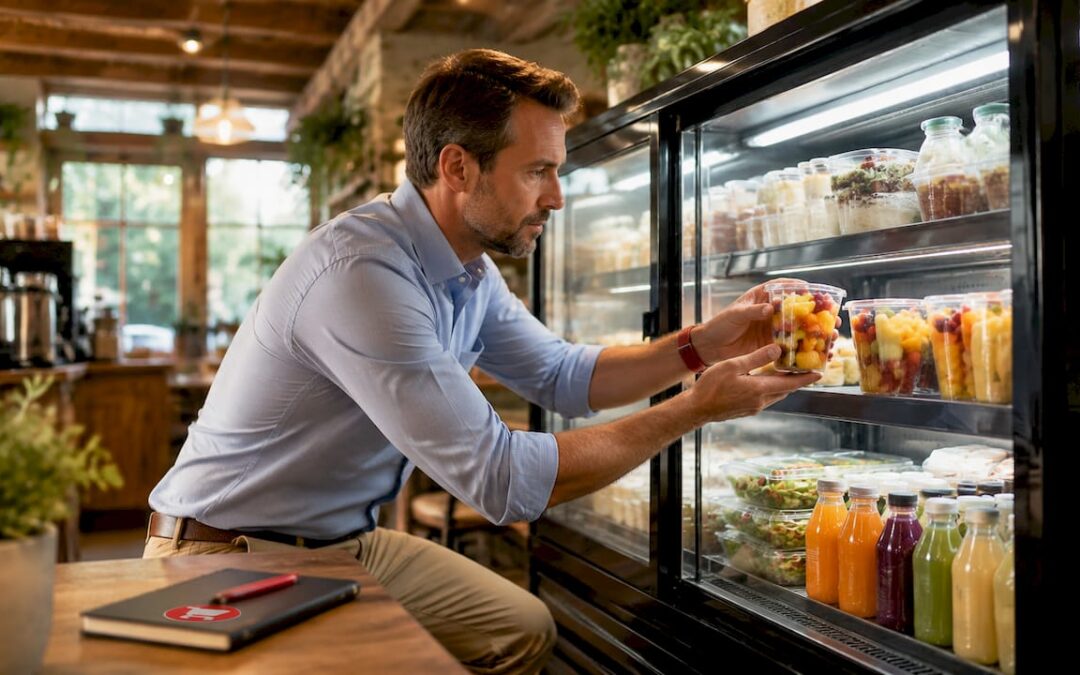
TL;DR:
- Grab-and-go display units are self-service fixtures that showcase chilled products to increase impulse sales and reduce labor costs. They come in three main formats: open-air merchandisers, glass-door display fridges, and countertop units, each suited to different store layouts and product types. Advances in technology, such as AI integration and hybrid layouts, enhance efficiency and inventory management in retail environments.
Grab-and-go display units are self-service retail fixtures that combine open or glass-fronted product presentation with precise refrigeration to drive impulse sales and reduce labour costs. The UK food-to-go sector grew 4.1% in 2023, and that momentum has pushed retailers to rethink how chilled products reach customers. Manufacturers including Atlantic Food Bars, Cayuga Displays, and Vending.com have responded with units that range from compact countertop coolers to full-scale open-air merchandisers. The result is a category of retail equipment that simultaneously solves product visibility, food safety, and operational efficiency in one fixture.
What types of grab-and-go display units are available?
Three primary formats define the market: open-air merchandisers, glass-door display fridges, and countertop units. Each serves a different retail context, and choosing the wrong format is one of the most common and costly mistakes store managers make.
| Format | Typical size | Best application |
|---|---|---|
| Open-air merchandiser | 6–20 cu.ft. | High-traffic impulse zones, sandwiches, snacks |
| Glass-door display fridge | 30–60+ cu.ft. | Beverages, dairy, pre-packaged meals |
| Countertop unit | 4–10+ cu.ft. | Till points, coffee stations, small format stores |
Open-air merchandisers remove every barrier between the customer and the product. That accessibility drives impulse purchases but comes at an energy cost, since the refrigerated zone is permanently exposed to ambient store heat. Glass-door units are more energy efficient because the door contains the cold air until a customer opens it. Countertop units are the most compact option and work well at till points where floor space is limited but impulse opportunity is high.
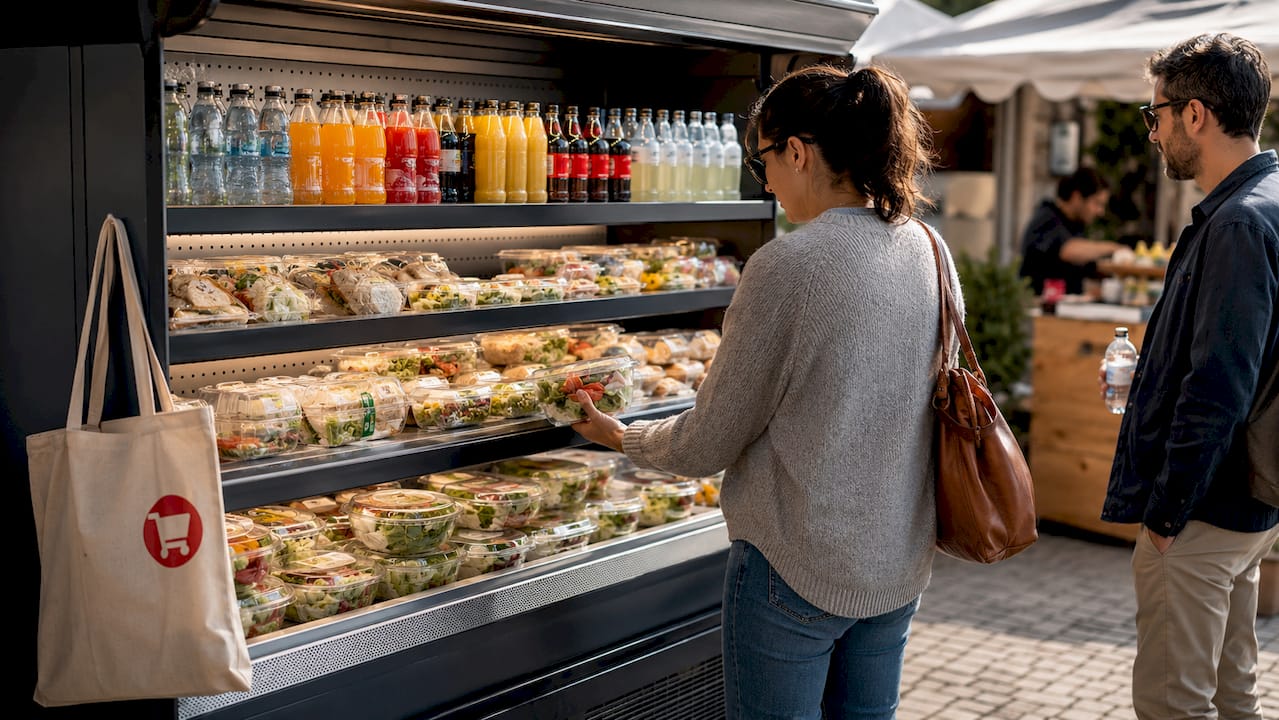
The right format depends on two factors: your store layout and your product mix. A petrol forecourt with a narrow aisle benefits from a countertop unit at the till. A supermarket deli section with high footfall suits a bank of open-air merchandisers. You can explore a full breakdown of retail display cabinet types to compare formats before committing to a purchase.
Pro Tip: If your store has variable foot traffic across the day, prioritise a format mounted on heavy-duty casters so you can reposition it without disrupting refrigeration.
What technical features preserve product quality in these units?
Temperature control is the non-negotiable foundation of any grab-and-go unit. Standard units maintain 2°C to 5°C using air curtain technology, which creates an invisible barrier of cold air across the open face of the unit to separate the chilled interior from the warmer store environment. That range covers most pre-packaged chilled goods, including sandwiches, salads, and dairy products.
| Technical feature | Retail benefit |
|---|---|
| Air curtain technology | Maintains temperature without a physical door |
| LED lighting | Improves product visibility and reduces energy use |
| Adjustable shelving | Accommodates varying product heights and pack sizes |
| Self-contained refrigeration | No plumbing required; relocate without specialist trades |
| Heavy-duty casters | Reposition unit to match changing foot traffic patterns |
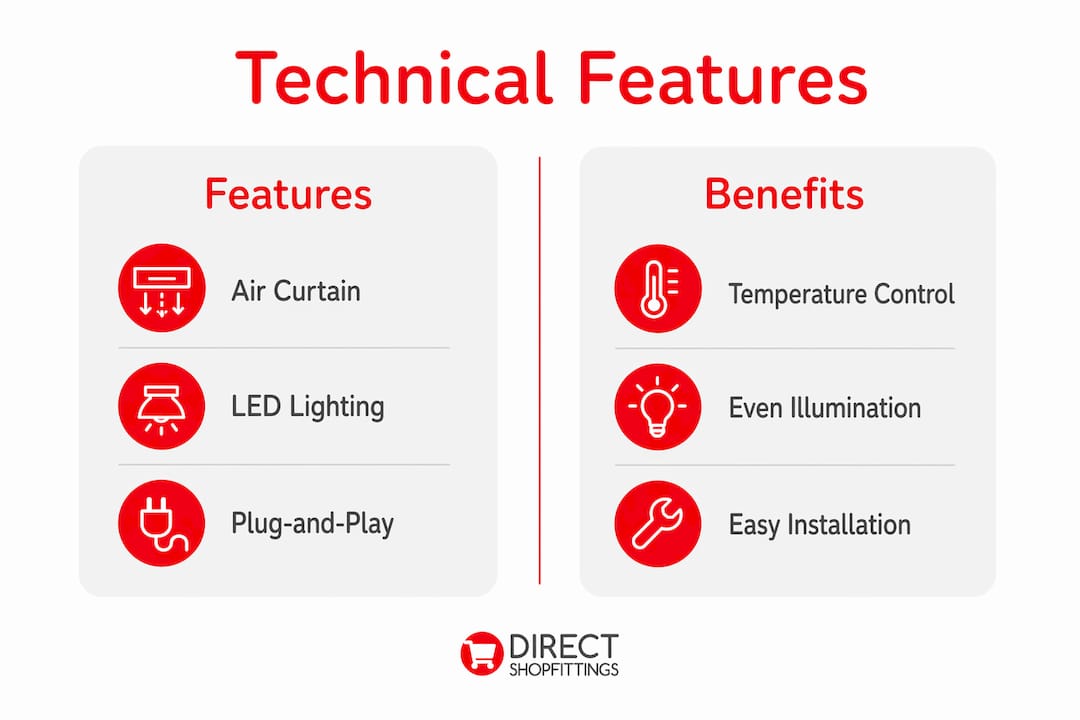
LED lighting is more than an aesthetic choice. It illuminates products evenly without generating the heat that older fluorescent tubes produced, which means the refrigeration system works less hard to maintain temperature. Adjustable shelving matters because product ranges change seasonally. A unit that cannot accommodate a taller bottle or a wider tray becomes a constraint rather than an asset.
Self-contained, plug-and-play units connect to a standard 115-volt outlet with no permanent refrigeration plumbing. That single feature transforms how retailers think about store layout. You are not locked into a fixed position because the unit was plumbed in during a fit-out. Cayuga Displays, for example, builds units on heavy-duty casters so managers can move displays to follow customer flow without calling a refrigeration engineer.
Pro Tip: Raw proteins require tighter temperature control of 0°C to 2°C. Standard grab-and-go units are not suitable for raw meat or fish. Use specialised cabinetry with stricter controls for those product lines.
What are the benefits of grab-and-go display units for retail operations?
The shift from staffed service counters to self-service grab-and-go units is the single biggest operational gain available to food retailers right now. Moving to self-service reduces labour overhead, increases sales velocity, and creates flexibility to rotate the menu without retraining staff. Those three outcomes compound quickly in a busy retail environment.
The operational benefits break down into four clear areas:
- Reduced labour costs. A self-service unit requires no serving staff. Customers select their own products, which frees team members for higher-value tasks like restocking, customer service, and till operation.
- Higher impulse sales. Open-air and countertop units place chilled products directly in the customer’s path. Proximity to the product at the point of decision is the most reliable driver of unplanned purchases.
- Shrink reduction. Retailers reduce waste by moving near-date items from full-service counters to grab-and-go shelves before those products become unsaleable. Atlantic Food Bars designs combination units specifically to enable that transition within a single fixture.
- Menu rotation flexibility. Adjustable shelving and modular formats let you swap product lines quickly. A unit stocked with summer salads in june can hold winter soups in december without any structural change.
Pro Tip: Place your highest-margin products at eye level and your highest-volume products at waist level. That split maximises both revenue per transaction and throughput speed.
Avoiding common retail display mistakes is just as important as choosing the right unit. Poor placement, inconsistent restocking, and ignoring temperature logs are the three errors that undermine otherwise well-chosen equipment.
How is grab-and-go technology evolving in 2026?
The next generation of grab-and-go units integrates artificial intelligence directly into the cabinet. Vending.com’s AI smart coolers use computer vision and real-time inventory tracking to support frictionless checkout, where customers take a product and walk away without scanning or queuing. The system logs the transaction automatically. That capability removes the last friction point in the self-service experience.
The broader technology shift is moving in two directions simultaneously:
- AI and computer vision for inventory tracking, automatic reordering, and checkout-free transactions.
- Hybrid display strategies that combine open-air and glass-door units within the same store zone to balance accessibility with energy efficiency.
The hybrid approach is already the preferred strategy among retailers with diverse product ranges. Open-air units handle high-turnover impulse lines where speed of access matters most. Glass-door units handle slower-moving, higher-value products where energy efficiency justifies the slight reduction in accessibility. Running both formats in the same zone gives you the sales benefits of open access and the running cost benefits of contained refrigeration.
The competitive implication is straightforward. Retailers who invest in smart coolers and hybrid layouts now will have lower labour costs, better stock visibility, and faster checkout than those still running single-format, manually managed units.
What should retailers consider when selecting a grab-and-go unit?
Selecting the wrong unit costs money twice: once at purchase and again in lost sales or compliance failures. Work through these six considerations before committing to a format.
- Assess your foot traffic pattern. High-volume, fast-moving locations suit open-air merchandisers. Lower-traffic zones with longer dwell times suit glass-door units where customers browse before opening the door.
- Match the unit to your product mix. Pre-packaged sandwiches and snacks work in standard 2°C to 5°C units. Raw proteins need 0°C to 2°C cabinetry. Mixing product types in a single unit creates food safety risk.
- Prioritise mobility if your layout changes seasonally. Units on heavy-duty casters with self-contained refrigeration give you the flexibility to reposition without a contractor. Cayuga Displays builds this into their Fresh Go range as standard.
- Choose plug-and-play over permanent installation where possible. Self-contained units that connect to a standard outlet are faster to deploy and easier to relocate. Custom units typically carry an 8–10 week lead time, so plan accordingly.
- Verify temperature recovery speed. A unit that drops below 5°C quickly after a door-open event is a compliance risk. Ask suppliers for temperature recovery data before purchasing.
- Plan a restocking and cleaning schedule. Grab-and-go units require daily restocking and regular condenser cleaning. A unit that looks full and clean sells more. A neglected unit loses customer trust faster than an empty shelf.
You can also review freestanding display unit formats to understand how grab-and-go units sit within the broader category of retail floor fixtures before finalising your specification.
Key takeaways
Grab-and-go display units deliver the strongest retail returns when format, temperature specification, and placement are matched precisely to product type and foot traffic pattern.
| Point | Details |
|---|---|
| Three core formats | Open-air, glass-door, and countertop units each suit different store zones and product types. |
| Temperature compliance | Standard units maintain 2°C to 5°C; raw proteins require specialised 0°C to 2°C cabinetry. |
| Mobility matters | Self-contained units on casters let you reposition displays without a refrigeration engineer. |
| Operational gains | Self-service reduces labour costs, increases impulse sales, and cuts shrink from near-date stock. |
| Technology direction | AI smart coolers and hybrid open/glass-door strategies are the leading formats for 2026 and beyond. |
What I have learned from watching retailers get this wrong
Most retailers I speak with focus almost entirely on price when selecting a grab-and-go unit. That is the wrong starting point. The unit that costs least to buy often costs most to run, either through high energy consumption, poor temperature recovery, or a fixed position that stops working when the store layout changes.
The retailers who get the most from these units do three things differently. They combine formats rather than standardising on one. They position units based on observed customer movement, not on what looks tidy to the manager. And they treat restocking as a sales activity, not a housekeeping task. A unit restocked at peak times, with the highest-margin products at eye level, consistently outperforms a unit that is simply topped up whenever it looks low.
The technology shift towards AI smart coolers is real, but it does not replace the fundamentals. A smart cooler in a poorly chosen location with inconsistent restocking will still underperform a basic open-air unit placed correctly and managed well. Invest in the right format first. Add technology when the fundamentals are working.
The shrink reduction argument is also underused. Moving near-date products from a staffed counter to a self-service unit before they become waste is one of the simplest margin improvements available to any food retailer. Atlantic Food Bars built a combination unit specifically for that transition. Most retailers I have spoken with are not using that capability deliberately. They should be.
— Lee
How DirectShopfittings can help you fit out your store
DirectShopfittings works with retailers across the UK, from independent boutiques to established retail chains, supplying the shopfitting equipment needed to build effective, compliant store environments. If you are planning a new grab-and-go zone or upgrading an existing display layout, the team can source hard-to-find fixtures quickly through their supplier network.
Whether you are fitting out a new store or reconfiguring an existing one, the shopfitting guide for small retailers is a practical starting point for understanding what equipment you need and in what order. DirectShopfittings also offers competitive pricing and rapid delivery, backed by a customer service team that retailers consistently rate highly for responsiveness. Browse the full retail equipment range to find display solutions that match your store format and budget.
FAQ
What are grab-and-go display units used for?
Grab-and-go display units are self-service retail fixtures that present chilled products at accessible heights, enabling customers to select items without staff assistance. They are used primarily for pre-packaged food, beverages, and dairy products in supermarkets, forecourts, and food-to-go outlets.
What temperature should a grab-and-go unit maintain?
Standard grab-and-go units maintain a temperature of 2°C to 5°C using air curtain technology. Raw proteins require specialised cabinetry operating at 0°C to 2°C to meet food safety requirements.
Can grab-and-go units be moved after installation?
Yes. Self-contained units with heavy-duty casters and plug-and-play refrigeration connect to a standard outlet and can be repositioned without a refrigeration engineer, making them well suited to stores with changing layouts.
What is the difference between open-air and glass-door grab-and-go units?
Open-air units have no physical barrier between the product and the customer, which maximises impulse purchase rates but uses more energy. Glass-door units are more energy efficient and suit slower-moving or higher-value products where customers are willing to open a door.
How long does a custom grab-and-go unit take to deliver?
Custom grab-and-go units typically carry a lead time of 8–10 weeks from order to delivery. Standard off-the-shelf formats are available significantly faster, which makes them the better choice for retailers with urgent fit-out timelines.