
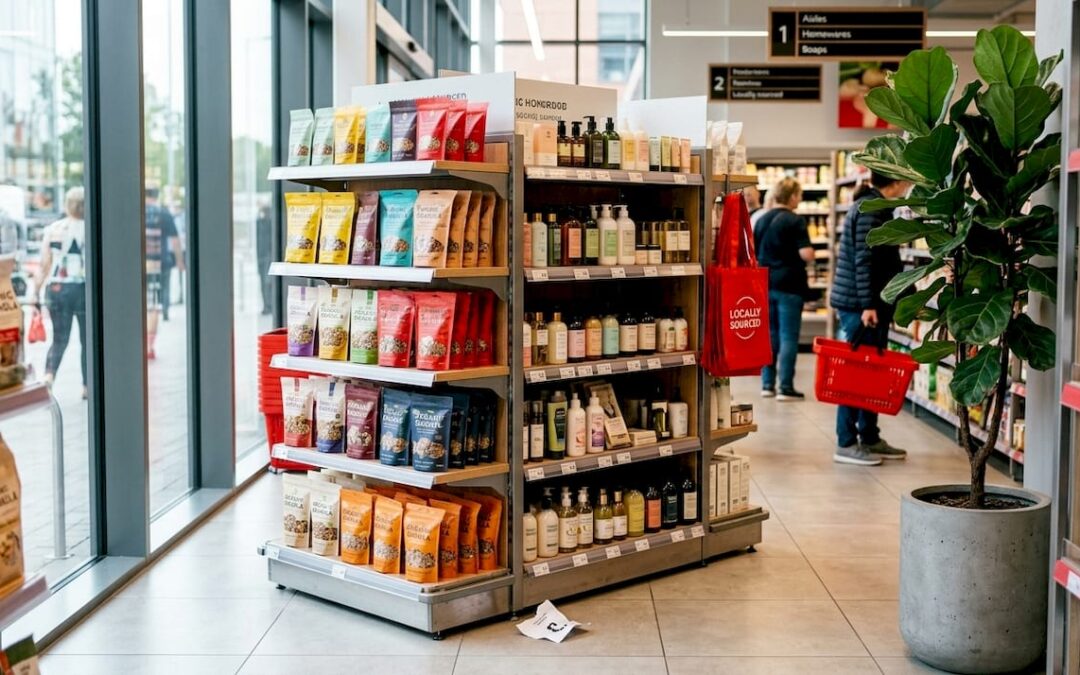
A freestanding display unit (FSDU) is a standalone retail display placed directly on the shop floor to showcase products and attract customer attention without being fixed to walls or shelving. Also called floor-standing displays, FSDUs operate independently of your store’s permanent fixture layout, which means you can position them wherever purchase decisions happen. With 76% of purchase decisions made in-store, the right FSDU placed in the right location is one of the most direct tools available for driving impulse sales and lifting product visibility.
What are freestanding display units and how do they work?
An FSDU is defined by its independence. It stands on its own base, requires no wall fixings, and can be moved, repositioned, or removed entirely without affecting your store’s permanent layout. The industry uses the acronym FSDU interchangeably with “floor-standing display unit” or simply “floor display.” Cardboard is the most common material for lightweight, short-campaign units, while metal and acrylic versions serve longer-term or premium applications.
The core function of an FSDU is to intercept shoppers at the point where they are most likely to make an unplanned purchase. Secondary displays including FSDUs influence impulse purchases by standing apart from fixed shelving and catching shopper attention through their three-dimensional, branded presence. Unlike a shelf bay, an FSDU presents products on all visible sides, creating a 360-degree brand moment that a flat gondola simply cannot replicate.
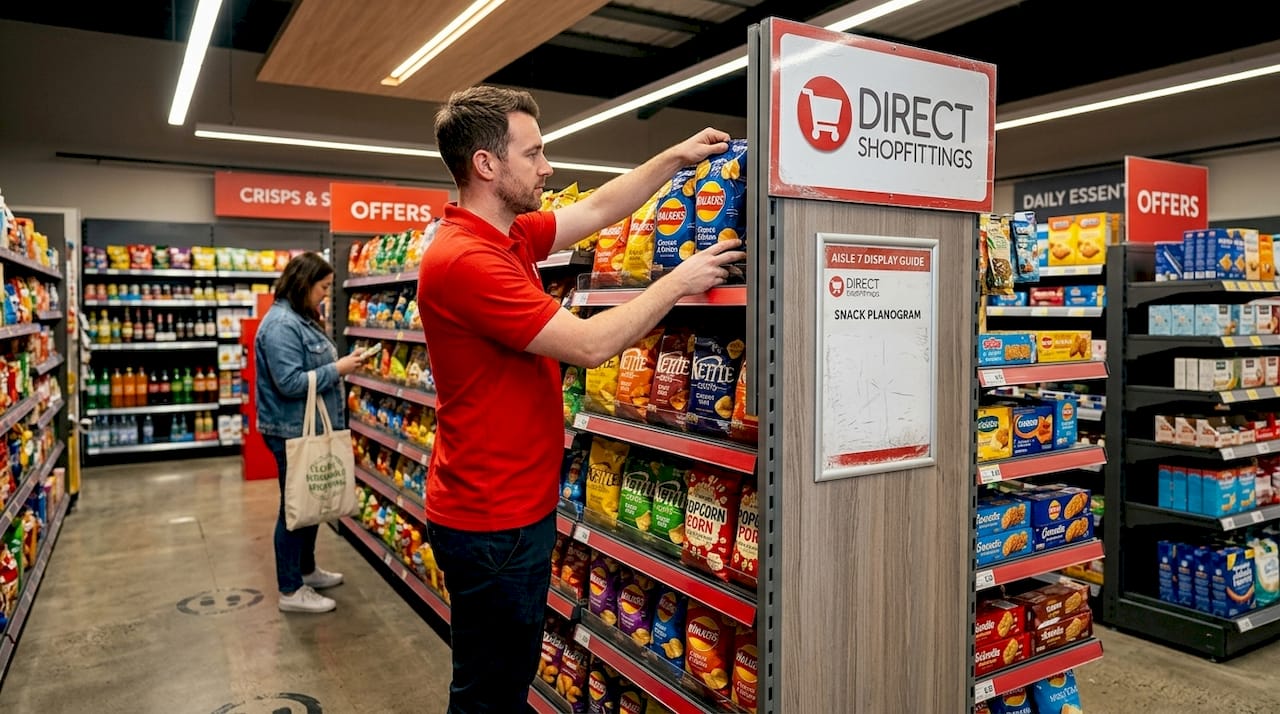
FSDUs are used across grocery, pharmacy, fashion accessories, electronics, and convenience retail. A confectionery brand placing a dump bin near a supermarket checkout and a cosmetics company positioning a shelved tower in a pharmacy aisle are both deploying the same fundamental tool. The format changes; the principle does not.
What are the main types of freestanding display units?
Common types of FSDUs include dump bins, hooked units, shelved units, showstopper displays, pallet wraps, and counter display units. Each format is designed around a specific product access style and shopping behaviour, so choosing the wrong type for your product is one of the most common and costly mistakes retailers make.
| FSDU type | Best suited for | Typical product examples |
|---|---|---|
| Dump bin | Bulk, loose, or low-cost items | Confectionery, toys, accessories |
| Hooked unit | Hanging packaged goods | Batteries, snacks, stationery |
| Shelved unit | Organised, upright products | Bottles, boxed goods, cosmetics |
| Showstopper display | High-impact brand moments | New launches, premium products |
| Pallet wrap | High-volume, heavy products | Soft drinks, canned goods |
| Counter display unit | Small, high-margin items | Gum, lip balm, travel accessories |
Dump bins work because they signal abundance and low price. Shoppers reach in freely, which suits impulse categories. Hooked units, by contrast, keep products visible and individually presented, which is critical for items where the packaging carries the purchase decision. Shelved units offer the most organised merchandising and suit categories where shoppers compare options before choosing.
Showstopper displays are the most structurally ambitious type. They are designed to stop shoppers mid-aisle through scale, colour, or unusual form. They are expensive to produce but deliver outsized brand impact for new product launches or seasonal campaigns. Pallet wraps convert a standard shipping pallet into a branded display, making them the most cost-efficient option for high-volume, heavy goods.
Pro Tip: Match your FSDU format to how shoppers naturally interact with your product category. A product that shoppers pick up and inspect individually needs a hooked or shelved unit. A product that sells on price and availability suits a dump bin. Getting this right before briefing your supplier saves significant redesign cost.
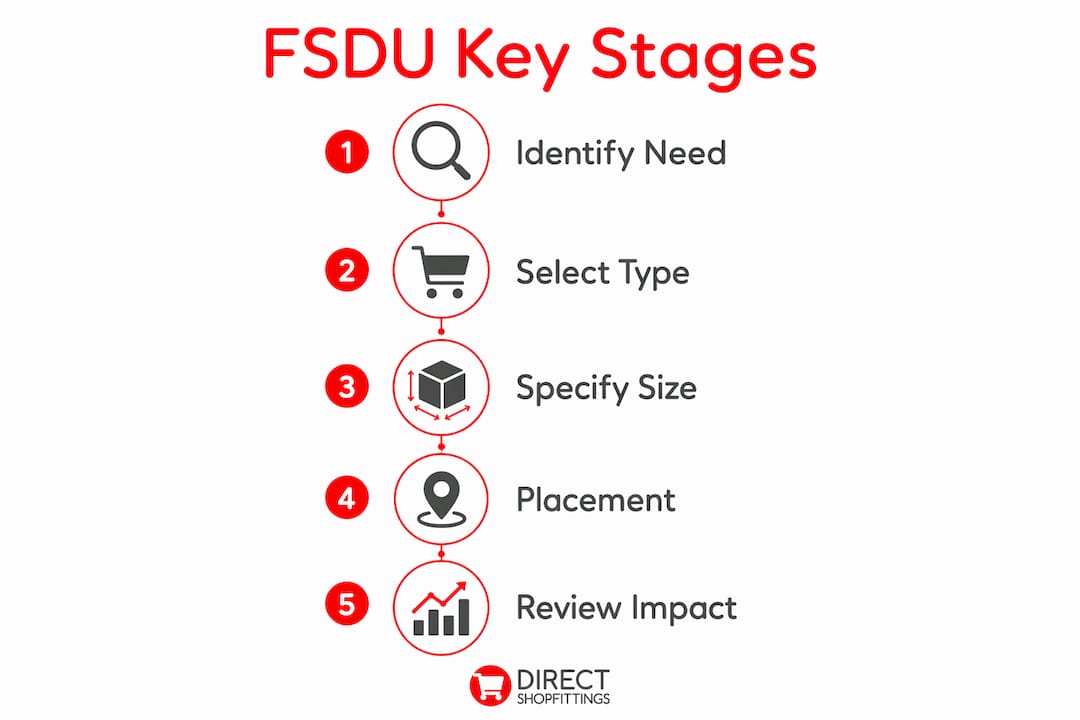
What physical specifications matter when choosing an FSDU?
Size, weight capacity, and structural stability are the three specification areas that most often cause FSDUs to fail in deployment. Getting them right at the design stage is far cheaper than discovering problems on the shop floor.
Typical FSDU footprints range from 400mm x 400mm to 600mm x 600mm. Units larger than this may require formal retailer approval and can incur premium placement fees. This is not a minor administrative detail. Retailers with high-footfall stores manage floor space as a revenue asset, and oversized units that obstruct customer flow will be refused or removed.
| Specification | Recommended guideline | Why it matters |
|---|---|---|
| Footprint | 400mm x 400mm to 600mm x 600mm | Avoids retailer approval thresholds |
| Shelf depth | 10–20% deeper than product footprint | Prevents products falling forward |
| Shelf spacing | 20–30mm taller than product height | Allows easy restocking by staff |
| Loaded weight | Plan for 20–30kg on shelved units | Ensures stability and safety compliance |
A fully loaded shelved FSDU can exceed 20 to 30kg, which has direct implications for base design and material choice. A cardboard unit that is structurally adequate when empty can become unstable or deform under full product load. Weight planning must happen at the design stage, not as an afterthought.
Shelf depth and spacing matched to product dimensions directly reduce restocking friction. When shelves are too shallow or too tight, store staff skip restocking or misplace products, and an empty or dishevelled FSDU is worse than no FSDU at all. Shelf depth should be 10 to 20% deeper than the product footprint, and shelf spacing should be 20 to 30mm taller than product height.
Pro Tip: Engage your retail partner early in the specification process. Retailer approval depends on exact unit size, walking clearance, and load stability. Presenting these figures at the outset prevents placement rejection after your units have already been manufactured.
How does placement maximise the impact of floor displays?
Placement is where the design investment either pays off or goes to waste. An FSDU positioned in a low-traffic area of a store will underperform regardless of how well it is built or branded. The unit must intercept shoppers at the moment they are most receptive to an unplanned purchase.
The highest-performing locations for freestanding display ideas in practice are:
- Aisle ends (gondola ends): High-traffic, high-visibility positions that shoppers pass on every circuit of the store.
- Checkout queues: Captive audience with time to browse. Ideal for small, low-cost impulse items.
- Promotional islands: Open floor space in the centre of a store or department, suited to showstopper displays and pallet wraps.
- Category adjacencies: Positioned next to a complementary product category to trigger cross-purchase behaviour.
- Store entrance zones: Captures attention immediately on entry, effective for seasonal or new product launches.
The three-dimensional nature of an FSDU is its structural advantage over flat shelving. Floor displays drive significant uplift precisely because they are highly visible from multiple angles and interrupt the shopper’s path in a way that a shelf bay cannot. A shopper walking an aisle will glance at shelf bays; they will physically navigate around an FSDU, which creates a moment of engagement.
Repositioning is one of the most underused benefits of portable display units. Because FSDUs are not fixed, you can test placement, measure sales uplift, and move the unit if performance is below expectation. Treat placement as an ongoing decision, not a one-time choice.
What practical pitfalls should retailers avoid with FSDUs?
The most common FSDU failures are not design failures. They are specification and operational failures that could have been avoided with better planning. Effective floor displays require structure, placement, and print quality working together. Branding alone does not sell products.
Key do’s and don’ts for FSDU deployment:
- Do match the unit format to how shoppers access your product category.
- Do plan shelf dimensions around your specific product size, not a generic template.
- Do confirm footprint and load specifications with your retail partner before manufacturing.
- Do treat restocking ease as a design requirement, not an operational afterthought.
- Don’t build a unit that looks impressive empty but becomes unstable when fully stocked.
- Don’t assume a larger unit will generate more sales. Oversized units risk retailer rejection.
- Don’t rely on branding alone. Structure and placement drive engagement; graphics reinforce it.
- Don’t ignore common retail display mistakes around dimensions and weight that undermine otherwise well-designed units.
Custom display unit designs offer a genuine competitive advantage when they are built around the product and the retail environment rather than a generic template. A unit designed for a specific bottle height, a specific shelf depth, and a specific store footprint will outperform a standard unit every time.
Key takeaways
Freestanding display units deliver measurable sales uplift when type, specification, and placement are matched precisely to the product and retail environment.
| Point | Details |
|---|---|
| Definition and function | An FSDU is a standalone floor display that operates independently of fixed shelving to intercept shoppers at the point of purchase. |
| Type selection | Match the FSDU format to product access behaviour: dump bins for bulk items, hooked units for hanging goods, shelved units for organised categories. |
| Size and weight | Keep footprints within 400mm x 400mm to 600mm x 600mm and plan for loaded weights of 20 to 30kg to meet retailer approval requirements. |
| Shelf dimensions | Set shelf depth 10 to 20% deeper than the product footprint and spacing 20 to 30mm taller than product height to reduce restocking friction. |
| Placement strategy | Position units at aisle ends, checkout zones, or promotional islands and treat placement as a testable, adjustable decision. |
What I have learned from watching FSDUs succeed and fail
The specification detail that most retailers underestimate is shelf spacing. I have seen well-funded campaigns produce beautifully printed units that store staff simply stopped restocking because the shelves were 15mm too tight to pull products forward quickly. The display looked full on day one and empty by day three. No amount of brand investment recovers that.
The other pattern I keep observing is the tendency to finalise unit design before speaking to the retail partner. Retailer requirements around footprint, walking clearance, and load stability are non-negotiable. A unit that has not been approved will be moved to a back corner or refused entirely. That conversation needs to happen at the brief stage, not after the artwork has been signed off.
What I find genuinely encouraging about the current retail environment is the shift toward flexible, portable display units that can be repositioned and repurposed across campaigns. Retailers who treat FSDUs as a fixed cost are missing the point. The ability to test, move, and optimise placement is one of the most underused advantages the format offers. Treat it as a live sales tool, not a one-time installation.
— Lee
How DirectShopfittings can help you find the right display unit
If you are sourcing freestanding display units for a retail environment or event space, DirectShopfittings offers an extensive range of retail display solutions to suit every product type and floor plan. Their supplier network covers both standard formats and custom-built units, with fast delivery times that keep your campaign timelines on track.
Whether you need a compact shelved tower for a pharmacy aisle or a high-volume pallet wrap for a grocery promotion, the team at DirectShopfittings can advise on specification, footprint, and material choice. Visit the site to browse the full range or contact the team directly for a sourcing consultation tailored to your product and retail partner requirements.
FAQ
What does FSDU stand for in retail?
FSDU stands for freestanding display unit. It refers to any standalone floor display that showcases products independently of fixed shelving or wall fixtures.
What are the most common types of freestanding display units?
The main types are dump bins, hooked units, shelved units, showstopper displays, pallet wraps, and counter display units. Each suits a different product access style and retail category.
What size should a freestanding display unit be?
Standard FSDU footprints range from 400mm x 400mm to 600mm x 600mm. Units larger than this typically require formal retailer approval and may incur additional placement fees.
What are freestanding bar displays?
Freestanding bar displays are a specific format of floor-standing unit that presents products along a horizontal bar or rail, typically used for hanging packaged goods such as snacks, accessories, or stationery.
How do I get a freestanding display unit approved by a retailer?
Submit exact footprint dimensions, loaded weight calculations, and walking clearance measurements to your retail partner before manufacturing. Retailers assess stability and floor space impact as the primary approval criteria.