

A retail gondola unit is a freestanding, double-sided shelving fixture used in retail stores to display products on both faces, maximising floor space and product visibility simultaneously. Known in the trade as gondola shelving, these units form the backbone of shop floor layouts in supermarkets, convenience stores, pharmacies, and independent retailers alike. If you are planning or refreshing your store layout, understanding what gondola units are and how they work is the single most useful place to start.
What is a retail gondola unit and how does it work?
A retail gondola unit consists of a central upright frame with shelving panels attached to both sides, allowing customers to browse products from either aisle. The structure is self-supporting, meaning it stands independently on the shop floor without wall fixation. This makes gondola shelving systems far more flexible than wall-mounted alternatives, since you can reposition entire runs as your product range or store layout evolves.
Gondola shelving provides 360-degree accessibility and is effective in maximising storage and display space across a wide range of retail formats. That accessibility translates directly into more product facings per square metre of floor space, which is why gondola units appear in virtually every category-led retail environment. A single gondola run in a convenience store, for example, can carry ambient grocery, confectionery, and household goods on opposite faces without any structural modification.
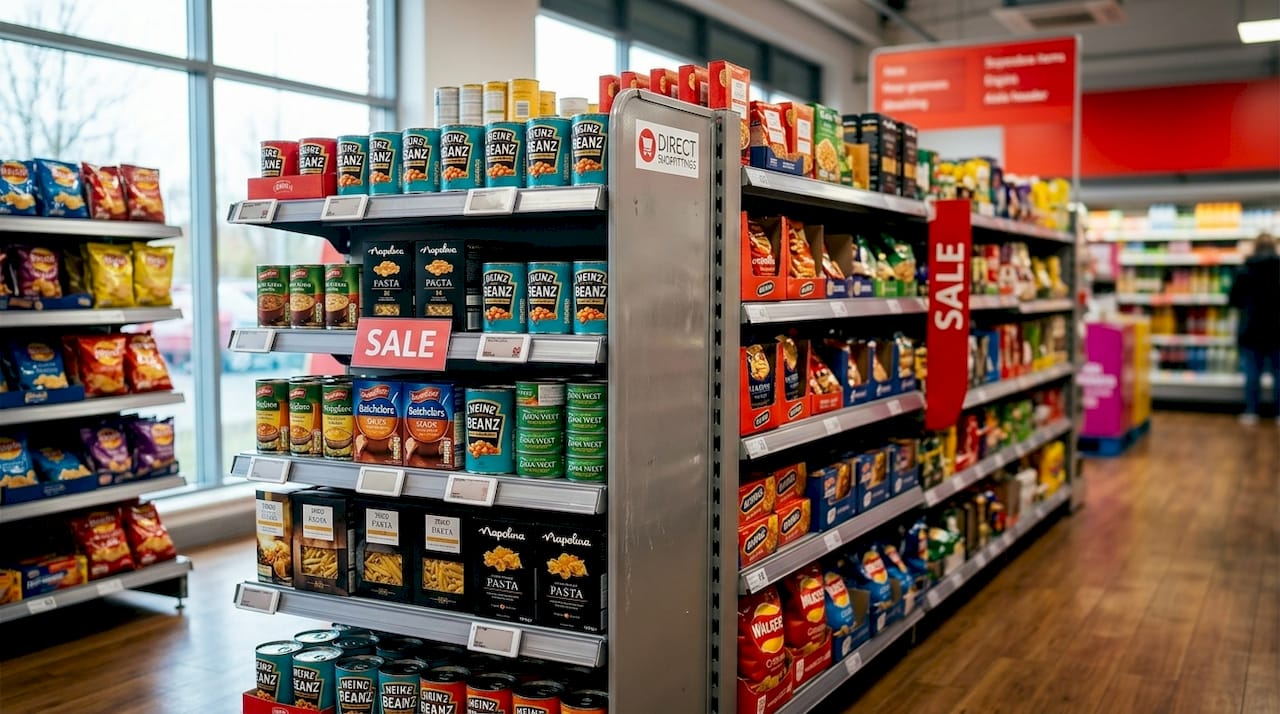
The term “gondola” originates from the Italian word for a flat-bottomed boat, a reference to the long, low profile of early supermarket fixtures. Today, the industry uses “gondola shelving” and “gondola unit” interchangeably, though “gondola shelving system” typically refers to a complete run of linked bays rather than a single standalone unit.
What are the common types of retail gondola units?
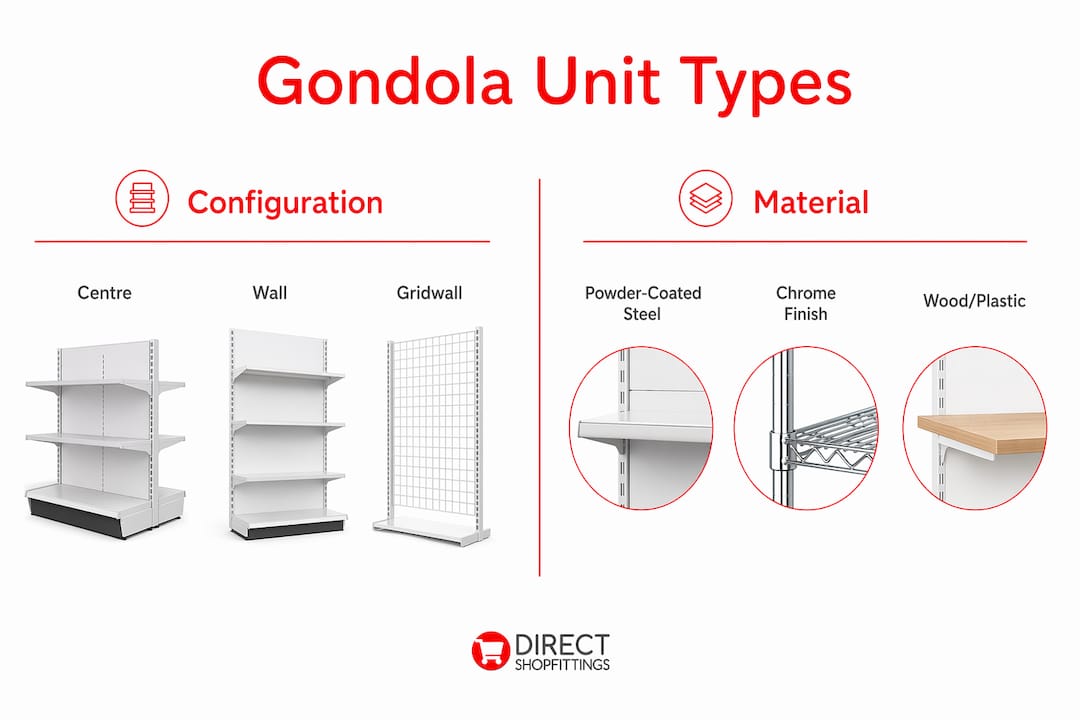
Gondola units come in several configurations, and choosing the wrong type for your store is a costly mistake. The three most common categories are centre gondolas, wall gondolas, and gridwall gondolas, each suited to different floor positions and product types.
Gondola shelving is modular with adjustable shelves and interchangeable back panels, available in standard heights from 48 inches to 96 inches. That range matters enormously for smaller stores, where a 96-inch unit can overwhelm a compact floor plan and block sightlines to the till area.
| Type | Configuration | Best use |
|---|---|---|
| Centre gondola | Double-sided, freestanding | Mid-floor aisles in supermarkets and mini-marts |
| Wall gondola | Single-sided, back-panel fixed | Perimeter walls and end-of-aisle positions |
| Gridwall gondola | Open grid panels, hooks and baskets | Apparel, accessories, and impulse buys |
- Centre gondolas are the workhorses of grocery and convenience retail. Centre gondola racks create well-organised aisles and improve customer movement in mini-marts and larger retail environments.
- Wall gondolas use a single-sided panel system and are typically taller, making full use of vertical space along perimeter walls.
- Gridwall gondolas replace solid back panels with open wire grids, giving you the flexibility to hang hooks, baskets, and display arms for irregular product shapes.
Materials range from powder-coated steel (the industry standard for durability) to chrome-finish units suited to fashion or beauty retail. Shelf depths typically run from 300mm to 500mm, and most modular systems allow you to mix depths within the same upright frame.
How do gondola shelving systems improve merchandising and customer experience?
The merchandising advantage of gondola shelving systems comes down to one structural fact: double-sided access improves shopper interaction and product browsing in ways that wall shelving simply cannot replicate. When a customer walks an aisle flanked by gondola units on both sides, they are exposed to twice the product range per metre walked compared to a single-sided wall layout.
Beyond exposure, gondola units give store owners precise control over customer flow. Positioning gondola runs parallel to the store entrance draws shoppers deeper into the floor plan, increasing dwell time and the likelihood of unplanned purchases. Retailers often position centre gondola racks to optimise aisle creation and customer movement in smaller stores, a tactic that works equally well in a 500 sq ft convenience store as in a 5,000 sq ft supermarket.
The specific merchandising advantages of gondola display units include:
- Increased product facings per square metre of floor space
- Consistent shelf heights that support planogram execution across multiple bays
- Modular accessories (dividers, shelf strips, price rail holders) that improve product organisation
- End-of-gondola (end cap) positions that command premium visibility for promotional lines
- Adjustable shelf spacing that accommodates everything from tall cereal boxes to small cosmetics
Pro Tip: Place your highest-margin products at eye level (roughly 1.2m to 1.5m from the floor) on the gondola face that customers see first as they enter an aisle. Reserve lower shelves for bulk or value lines, and upper shelves for secondary options. This three-tier approach mirrors the planogram logic used by major grocery multiples and works at any store scale.
What role do planograms play in optimising gondola units?
A planogram is a visual schematic that specifies the exact placement of every SKU on a retail fixture, including which shelf, which position, and how many facings each product receives. Planograms map product placement, shelf location, and facings from category strategy all the way through to shop floor execution. Without a planogram, gondola shelving becomes a storage solution rather than a merchandising tool.
The relationship between gondola units and planograms is structural. A gondola’s modular design, with fixed upright positions and adjustable shelf heights, maps directly onto the grid logic that planogram software uses. Each bay width (typically 900mm or 1,000mm) becomes a planogram module, and each shelf becomes a row of facings. The planogram acts as an operational link between the central merchandising strategy and shelf-level execution, so the shelf looks consistent with head office plans once executed correctly.
| Element | Planogram | Store floor plan |
|---|---|---|
| Focus | Individual SKU placement and facings | Overall store layout and traffic flow |
| Scale | Bay and shelf level | Whole store |
| Frequency of change | Category review cycles (quarterly or seasonal) | Major refits only |
| Primary user | Category manager or merchandiser | Store manager or shopfitter |
Pro Tip: If you run a small independent store without dedicated category management software, a simple spreadsheet planogram works well. Map each gondola bay as a column, each shelf as a row, and note the product name, facing count, and shelf position. Review it every quarter alongside your sales data to identify slow-moving facings that could be replaced.
How to choose and set up the right gondola unit for your store
Selecting the right gondola shelving for a small or medium retail store is a practical process, not a theoretical one. Effective gondola unit setup involves measuring store layout, choosing appropriate shelving types, and integrating accessories such as stacking baskets for versatile display. The steps below give you a repeatable process for getting it right first time.
- Measure your floor plan accurately. Record the total floor area, ceiling height, and any fixed obstacles (pillars, service counters, fire exits). Allow a minimum aisle width of 900mm between gondola runs to meet accessibility standards and support comfortable customer flow.
- Define your product categories. Group your SKUs by category and estimate the shelf space each category needs. This tells you how many bays per gondola run you require and whether you need different shelf depths for different sections.
- Choose gondola height relative to store size. In stores under 1,000 sq ft, units above 1.5m can make the space feel enclosed. Mid-height units (around 1.2m to 1.5m) maintain sightlines to the till and create a more open atmosphere. Taller units suit larger floor plans where sightlines are less critical.
- Select modular accessories before ordering. Stacking baskets, shelf dividers, price rail holders, and end-cap display panels are all standard accessories for most gondola shelving systems. Ordering them alongside the base units saves time and avoids compatibility issues later.
- Plan your gondola runs on paper first. Sketch the floor plan with gondola positions marked, showing aisle widths and customer entry points. Confirm that the layout creates a logical customer journey from entrance to till without dead ends.
- Install uprights on a level surface and check alignment. Most gondola systems use a base leg and upright post assembly. Ensure uprights are plumb before attaching shelves, since misaligned uprights cause shelf sag and make planogram execution inconsistent.
Pro Tip: Mix shelf depths within a single gondola run by using 300mm shelves for small products (health and beauty, confectionery) and 400mm or 500mm shelves for larger items (cereals, cleaning products). Most modular gondola systems support this within the same upright frame, and it prevents wasted shelf space caused by forcing large products onto shallow shelves.
You can find detailed configuration guidance in the gondola setup guide for small shops from DirectShopfittings, which covers bay widths, accessory compatibility, and layout planning for stores under 2,000 sq ft.
Key takeaways
Gondola shelving units are the most space-efficient retail display fixture available to small and medium store owners, and their value multiplies when combined with a planogram that links merchandising strategy to shelf-level execution.
| Point | Details |
|---|---|
| Core definition | A gondola unit is a freestanding, double-sided shelving fixture that maximises product display on both faces. |
| Three main types | Centre, wall, and gridwall gondolas each serve distinct floor positions and product categories. |
| Merchandising impact | Double-sided access doubles product exposure per metre walked compared to wall shelving alone. |
| Planogram integration | Planograms map exact SKU placement on gondola shelves, turning storage into a strategic merchandising tool. |
| Setup priority | Measure floor space, define categories, and select accessories before ordering to avoid costly reconfigurations. |
Why gondola units are worth getting right from the start
I have seen store owners spend weeks agonising over paint colours and signage, then order gondola units as an afterthought based on price alone. That is the wrong order of priorities. The gondola layout is the skeleton of your store. Everything else, the lighting, the signage, the promotional displays, hangs off it. Get the skeleton wrong and no amount of decoration fixes the problem.
The most common mistake I see in smaller stores is choosing units that are too tall for the floor plan. A 96-inch gondola in a 600 sq ft store does not create a premium feel. It creates a maze. Customers lose sight of the till, feel uncertain about where to go next, and leave faster. Mid-height units at 1.2m to 1.5m keep the space open and the customer in control of their journey.
The second mistake is ignoring accessories at the point of purchase. Shelf dividers, price rail holders, and stacking baskets are not optional extras. They are the difference between a gondola that looks merchandised and one that looks stocked. The retail display mistakes guide from DirectShopfittings covers this in detail, and it is worth reading before you finalise any order.
My honest recommendation: treat your gondola layout as a planogram in itself. Before a single unit arrives, sketch every bay, every shelf height, and every product category on paper. Then order. You will save money, time, and the frustration of a refit six months later.
— Lee
Explore gondola shelving solutions at DirectShopfittings
DirectShopfittings stocks a full range of gondola shelving systems suited to small and medium retail stores, from compact mid-height centre gondolas to full-height wall units with modular accessory compatibility.
Whether you are fitting out a new store or reconfiguring an existing layout, the team at DirectShopfittings can help you identify the right gondola units, bay widths, and accessories for your floor plan and product range. With rapid delivery times and a supplier network that covers hard-to-source configurations, DirectShopfittings removes the guesswork from retail display investment. Browse the full range and request a quote directly on the website.
FAQ
What is a retail gondola unit in simple terms?
A retail gondola unit is a freestanding, double-sided shelving fixture used in shops to display products on both faces of the unit, creating aisles and maximising floor space.
What are the main types of gondola displays?
The three main types are centre gondolas (double-sided, mid-floor), wall gondolas (single-sided, perimeter), and gridwall gondolas (open grid panels for hooks and baskets). Each type suits a different store position and product category.
How tall should a gondola unit be for a small store?
For stores under 1,000 sq ft, mid-height gondola units between 1.2m and 1.5m are recommended to maintain sightlines and avoid a cramped atmosphere. Taller units (up to 96 inches) suit larger floor plans where visibility is less of a concern.
How do planograms work with gondola shelving?
A planogram specifies the exact shelf position and facing count for every SKU on a gondola unit, ensuring consistent shelf execution that matches the retailer’s category strategy. Without a planogram, gondola shelving functions as storage rather than a merchandising asset.
Can gondola shelving units be reconfigured after installation?
Yes. Most gondola shelving systems use modular uprights with adjustable shelf brackets, meaning shelf heights, depths, and accessories can be changed without replacing the base structure. This makes gondola units a long-term investment that adapts as your product range changes.