
TL;DR:
- Retail lighting and shelving integration involves combining lighting systems with shelves to enhance product visibility and boost sales. Proper planning, modular components, and early coordination prevent costly rework and ensure uniform vertical illumination at product face height. Incorporating photometric testing and future-proofing measures creates a flexible, maintenance-friendly store environment.
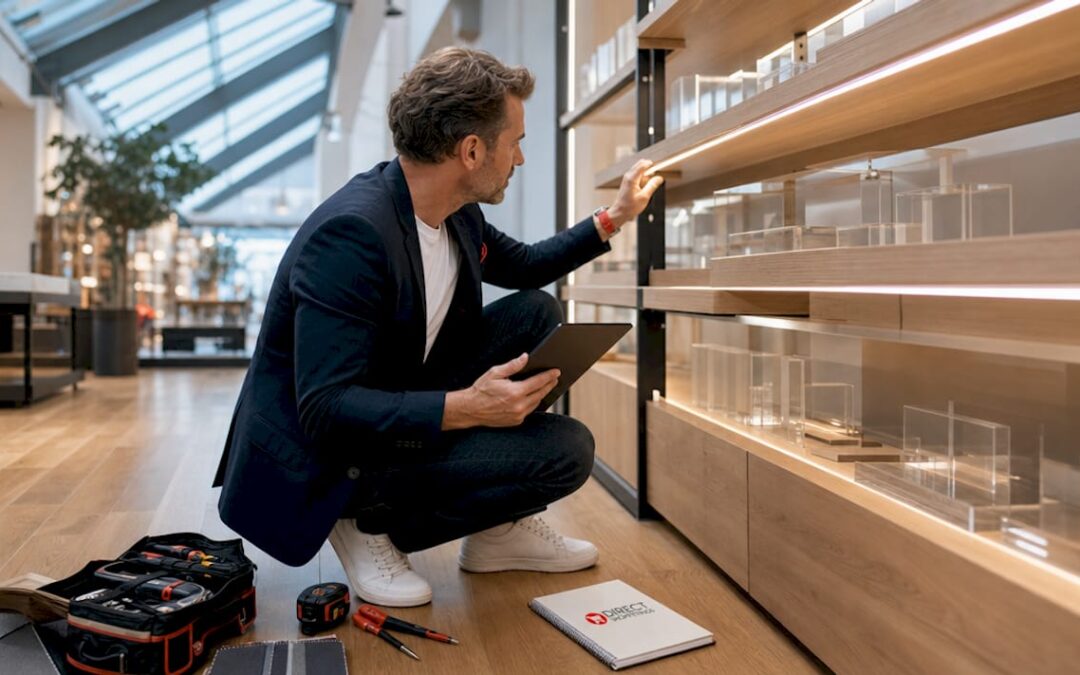
Retail lighting and shelving integration is the deliberate combining of lighting systems with shelving units to direct precise vertical illumination onto product faces, creating a shopping environment that improves visibility and drives purchase decisions. Done well, it is one of the highest-return investments a store owner can make. Done poorly, it produces glare, dead zones, and costly rewiring every time a shelf moves. This guide covers the tools, planning principles, installation steps, and troubleshooting fixes that retail professionals need to get it right the first time, drawing on systems like Parify Lighting’s ASIS, Visplay’s Beam EVO, and LED optics technology from Asahi Optics.
What is retail lighting and shelving integration?
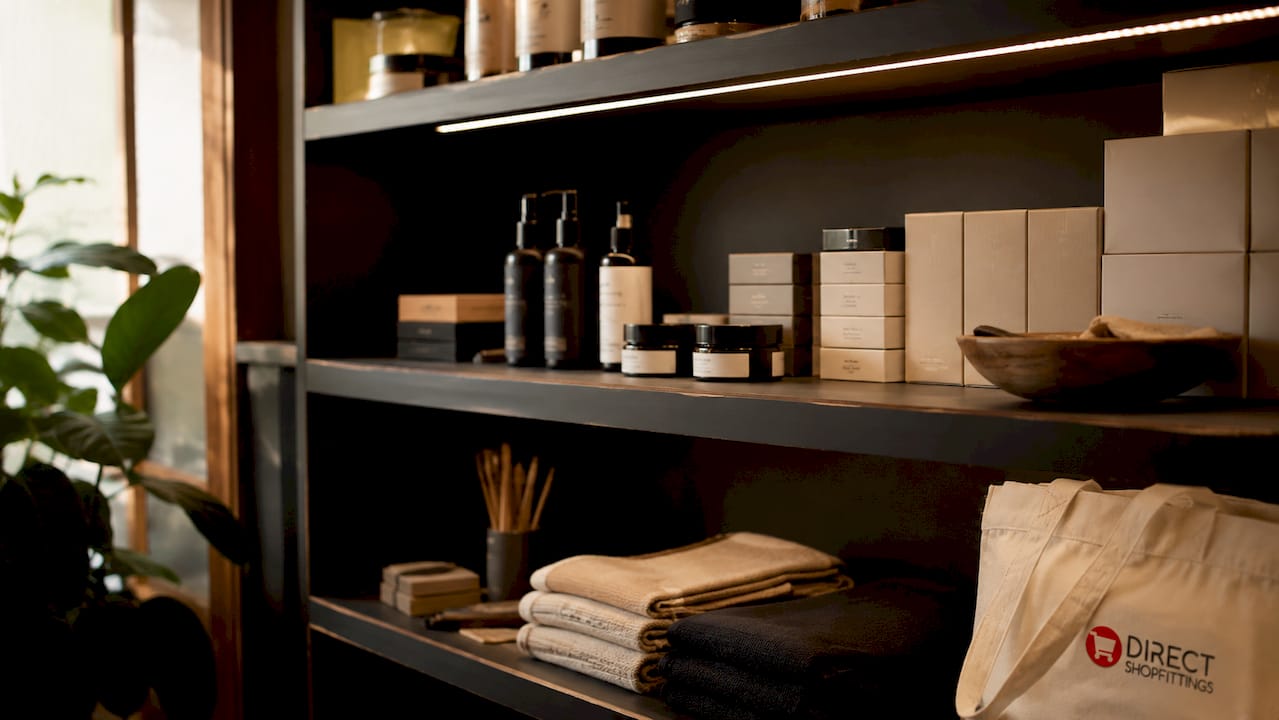
Shelf lighting must be treated as targeted vertical illumination, not a by-product of ceiling ambience. The industry term for this discipline is integrated shelf illumination, and it covers every decision from fixture selection and driver placement to shelving frame specification and cabling routes. Retail lighting and shelving integration sits within this broader discipline, specifically addressing how the physical shelving structure and the lighting system are designed and installed as a single coordinated system rather than two separate trades.
The commercial case is straightforward. Products that are well lit at face height are easier to read, more visually appealing, and more likely to be picked up. Glare and hotspots reduce label readability and perceived product quality, which means poor integration actively costs sales. For store owners managing everything from ambient zones to promotional endcaps, treating lighting as part of the shelving specification from day one removes the most common and expensive failure points.
What tools and materials do you need for effective integration?
Successful integrated shelf illumination requires the right hardware at every layer of the system. The list below covers the core components.
- LED strip lights for continuous linear emphasis along shelf edges, particularly in ambient and chilled sections where colour rendering and uniformity matter most.
- Adjustable spotlights and track lighting for premium displays, promotional endcaps, and areas where beam direction needs to change with the product mix.
- Modular electrified shelving frames such as Visplay’s Beam EVO or the Evolve S50i modular shelving range, which are designed to carry power and data within the upright structure.
- Batwing double-asymmetric lenses to control glare and direct light sideways onto product faces rather than into shoppers’ eyes.
- Low-voltage power supplies and LED drivers, sized to the total fixture load with at least 20% headroom for future additions.
- Cable management profiles and conduit, planned before fabrication to avoid clashes with shelf brackets and drawer runners.
| Component | Purpose | Key specification |
|---|---|---|
| LED strip lights | Continuous shelf-edge illumination | CRI ≥ 90, colour temperature matched to product category |
| Adjustable spotlights | Directional accent and promotional lighting | Beam angle 15°–36°, dimmable |
| Batwing optic lenses | Glare control and vertical uniformity | Double-asymmetric distribution |
| Modular electrified frame | Carries power within shelving upright | Tool-free connector system |
| LED driver | Converts mains to low-voltage DC | Sized with 20% load headroom |
Pro Tip: Specify drivers with a service loop of at least 300mm of accessible cable at the connection point. This single detail prevents the most common maintenance complaint after handover: technicians unable to reach connections without dismantling the entire bay.
How do you plan lighting placement alongside shelving layouts?
Planning is where most integration projects succeed or fail. The starting point is vertical illuminance targets. Recommended vertical illuminance levels vary by zone: standard shelves require 500 to 750 lux, promotional shelves 750 to 1,000 lux, and ambient zones 300 to 500 lux. These figures are not arbitrary. They reflect the contrast ratios needed to make products stand out against their background at typical shopper viewing distances.
A structured planning process follows this sequence:
- Map the retail zones. Identify general shelving runs, promotional endcaps, bakery sections, chilled aisles, and any areas subject to seasonal change. Each zone has different illuminance targets and may need different fixture types.
- Generate photometric data. Use dialux or a lighting designer’s photometric report to validate that your proposed fixture positions achieve the target lux levels at 1.5 metres height, which is the standard product-face measurement point.
- Check vertical uniformity. The target uniformity ratio is no worse than 3:1 lux maximum to minimum across a single shelf run. Vertical illuminance can drop 45 to 68% in high-ceiling stores, so horizontal lux readings alone will mislead you.
- Coordinate fixture positions with shelf bracket holes. On modular systems, confirm that the lighting track or strip position does not conflict with the bracket pitch. This is the step most often skipped and most often regretted.
- Plan driver and power feed locations. Drivers and power feeds must be integrated within the millwork package before fabrication, not retrofitted afterwards. Identify a service zone in each bay, typically at the top or base of the upright, with clear access from the aisle.
- Design for shopper sight lines. Position fixtures at the front edge of the shelf above, or recessed into a profile, so the light source itself is never directly visible to a shopper standing at normal browsing height.
Pro Tip: Commission a physical mock-up of one complete bay before ordering the full fit-out. A single bay mock-up costs a fraction of the rework bill if the driver placement or optic choice is wrong across 200 bays.
Step-by-step: how to install integrated shelf lighting
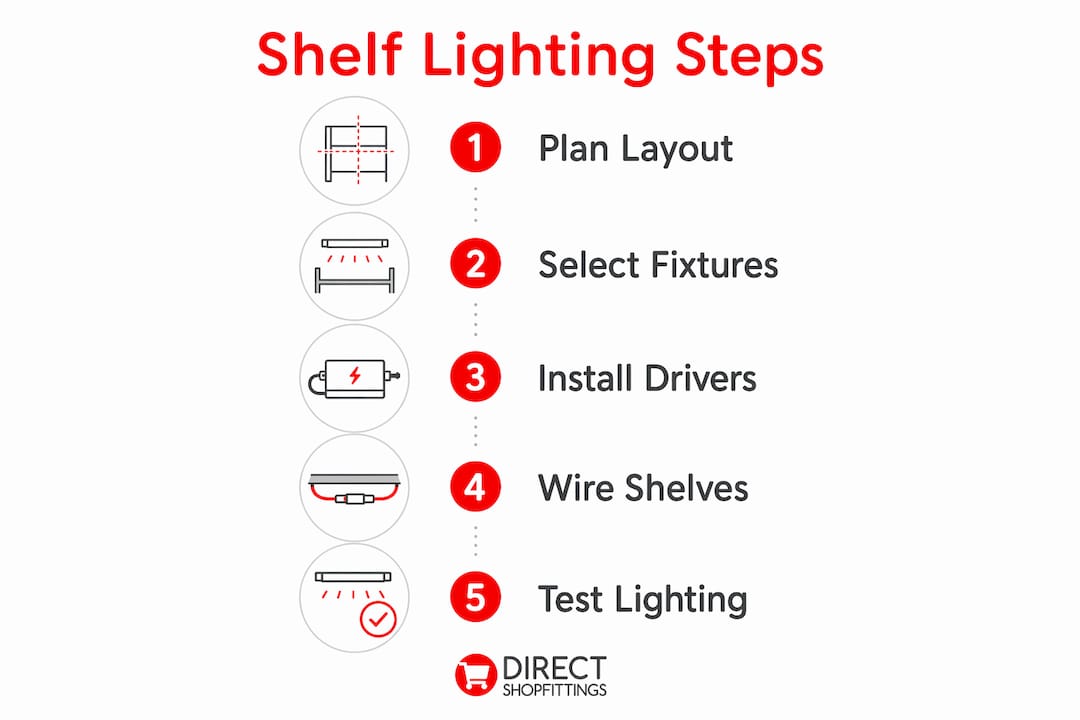
With the plan confirmed and materials on site, installation follows a logical sequence that keeps electrical work and joinery work coordinated.
- Install power infrastructure first. Run mains cabling to each bay position, terminate at the driver location, and label every circuit before any shelving goes up. Attempting to run cables through an assembled bay is the single biggest cause of installation delays.
- Mount the shelving uprights and base rails. On modular electrified systems, connect the low-voltage bus bar within the upright at this stage, before the shelves are loaded.
- Fit the lighting track or LED strip profile. On track systems, clip the track into the upright connector. On strip systems, press the strip into its aluminium extrusion profile and connect to the driver output. PMMA extrusion lenses can be cut to custom lengths and control beam angles precisely, making them well suited to non-standard bay widths.
- Load the shelves and adjust heights. On systems like Parify Lighting’s ASIS, shelf height changes require no rewiring. The system supports up to 10 shelves per track with tool-free, quick-connect fittings, so the lighting position adjusts with the shelf automatically.
- Set optic direction and beam angle. For spotlights, aim the beam at the product face, not the shelf surface. For strip lighting with batwing lenses, batwing optics reduce glare and focus light sideways along the aisle, which is the correct distribution for long shelf runs.
- Measure and verify. Take vertical lux readings at product face height across the full bay. Compare against your photometric targets and adjust fixture positions or dimmer settings before signing off.
| Fixture type | Advantages | Disadvantages |
|---|---|---|
| LED strip lights | Continuous uniform line, low profile, low cost | Limited beam control without optic profile |
| Adjustable spotlights | Precise directional control, easy to repoint | Visible light source, potential glare if misaimed |
| Linear shelf luminaires | Integrated optics, clean appearance, high uniformity | Higher upfront cost, fixed beam angle |
Pro Tip: Always illuminate the product face, not the shelf surface. A common mistake is angling strip lights downward onto the shelf board, which creates a bright shelf and a dark product. The light needs to travel forward and slightly downward to hit the label at eye height.
What are the most common problems in shelf lighting integration?
Even well-planned projects encounter predictable problems. Knowing them in advance reduces both cost and frustration.
- Glare from exposed light sources. Fixtures mounted too far back in the shelf profile, or strip lights without diffuser profiles, create direct glare that shoppers find uncomfortable. The fix is a batwing or diffuser optic fitted to the strip, or repositioning the fixture to the front edge of the shelf above.
- Uneven illumination and visual dead zones. These appear at the ends of shelf runs or at bay junctions where fixture spacing was not calculated against the beam angle. Photometric planning before installation eliminates this; photometric measurement after installation catches it before the store opens.
- Rework fatigue from shelf adjustments. Electrical rewiring during shelf height adjustments increases operational costs significantly. Specifying a modular track system at the outset removes this problem entirely.
- Driver access conflicts. Drivers buried behind fixed panels or inside sealed plinths become a maintenance liability within 18 months. Plan a dedicated service zone in every bay during the design phase.
- Vertical illuminance drop in high-ceiling stores. Vertical lux measurements at product face height are the only reliable way to validate performance in stores with ceilings above 4 metres. Horizontal lux values misrepresent actual visibility in these environments.
Designing lighting integration as part of the retail display system, rather than an afterthought, enhances maintenance friendliness and visual harmony across the entire store.
For stores also managing retail air conditioning and shelving integration, the same principle applies: mechanical services, lighting, and shelving must be coordinated in the design phase, not resolved on site.
How do you future-proof your integrated retail lighting system?
The stores that avoid costly rework share one characteristic: they chose modular systems at the outset. Visplay’s Beam EVO system combines in-shelf lighting with digital features in a clean modular framework, allowing retail interiors to evolve without disrupting wiring or visual neatness. This approach reflects a broader industry shift towards electrified shelving that treats power and data as built-in infrastructure, not an add-on.
Practical steps to future-proof your installation include:
- Specify plug-and-play lighting tracks rather than hard-wired strip connections, so fixtures can be swapped or repositioned without an electrician.
- Use modular power distribution rails within uprights, allowing new shelves or lighting zones to be added by connecting to the existing bus bar.
- Build in digital control capability. DALI or 0-10V dimming circuits within the shelving structure allow you to adjust lighting levels for seasonal promotions or time-of-day programmes without touching the hardware.
- Design maintenance access into every bay. A removable back panel or a dedicated service channel at the upright base adds minimal cost at installation and saves significant time over the life of the fit-out.
- Plan for promotional flexibility. Endcap positions and feature bays should have higher-capacity circuits and adjustable spotlights from day one, so seasonal display changes require only a product swap, not an electrical alteration.
For a detailed overview of shelving systems that support electrical integration, the retail shelving buyers guide from DirectShopfittings covers the key specifications to look for when sourcing modular frames.
Key takeaways
Effective retail lighting and shelving integration requires coordinated planning of vertical illuminance targets, modular fixture systems, and driver placement before a single shelf is assembled.
| Point | Details |
|---|---|
| Treat lighting as vertical illumination | Target 500 to 1,000 lux at product face height, not ceiling-level horizontal lux. |
| Plan driver placement before fabrication | Integrate power feeds within the millwork package to avoid costly access conflicts later. |
| Choose modular track systems | Systems like Parify ASIS eliminate rewiring when shelf heights change, reducing operational costs. |
| Validate with photometric data | Measure vertical lux at 1.5m height; uniformity ratio must not exceed 3:1 across a bay. |
| Design for future change | Plug-and-play tracks and DALI dimming circuits allow layout changes without electrical rework. |
Why integrated planning is the only approach worth taking
The projects I have seen go wrong share a common origin: the lighting specification was finalised after the shelving layout was locked. At that point, every compromise is expensive. Drivers end up in inaccessible locations. Tracks conflict with bracket holes. Electricians are cutting circuits that the joinery team installed last week. The rework bill on a mid-size supermarket fit-out can run to tens of thousands of pounds, and almost all of it is avoidable.
The counter-intuitive lesson is that the visual merchandising team needs to be in the room during the shelving specification meeting, not brought in at the end to “dress” a completed installation. Lighting affects how every product category reads to a shopper. A bakery section lit at 500 lux looks flat and uninviting. A chilled aisle with exposed strip lights and no diffuser profile looks harsh and cheap. These are not aesthetic preferences. They are commercial outcomes.
My strongest recommendation is to commission photometric testing on a physical mock-up before committing to a full fit-out. The cost is modest. The information it provides, specifically whether your chosen fixture at your chosen position actually delivers the target lux at product face height, is irreplaceable. No simulation fully replicates the interaction between your specific shelving profile, your specific optic, and your specific ceiling height. The mock-up does.
Modular systems are not a premium option. They are the cost-effective option when you account for the full operational life of the store. A fit-out that requires an electrician every time a shelf moves is not a fit-out. It is a recurring liability. Avoiding common retail display mistakes from the outset, including poor lighting placement, is what separates stores that perform from stores that merely open.
— Lee
How DirectShopfittings can support your project
DirectShopfittings supplies retail shelving systems built for the demands of integrated lighting projects, from modular uprights with electrical compatibility to display-ready frames suited to LED strip and track installations.

Whether you are fitting out a single boutique or a multi-aisle grocery environment, the team at DirectShopfittings can help you source shelving that works with your lighting specification from day one. Their supplier network covers hard-to-find modular components, and their rapid delivery times mean your project timeline stays on track. Browse the full range of retail equipment and supplies to find shelving systems, display fixtures, and shopfitting accessories suited to integrated lighting environments.
FAQ
What lux level should retail shelves be lit to?
Standard retail shelves require 500 to 750 lux of vertical illuminance at product face height, while promotional shelves need 750 to 1,000 lux. Final targets depend on product reflectance, brand goals, and the ambient lighting level in the surrounding zone.
What is the best lighting type for retail shelving?
LED strip lights with batwing optic profiles deliver the most consistent vertical illuminance across long shelf runs. Adjustable spotlights are better suited to promotional endcaps and premium displays where directional control matters more than uniformity.
How do I avoid rewiring when I change shelf heights?
Specify a modular track system such as Parify Lighting’s ASIS, which allows shelf height adjustments without any electrical rewiring. The lighting position moves with the shelf automatically via tool-free connectors.
Why does my shelf lighting look uneven in a high-ceiling store?
Vertical illuminance drops 45 to 68% in high-ceiling retail spaces. Horizontal lux measurements at floor level do not reveal this problem. Measure vertical lux at 1.5 metres height across the full bay to identify and correct dead zones.
When should lighting be specified in a retail fit-out?
Lighting must be specified at the same time as the shelving layout, not after it is finalised. Driver placement, cable routes, and fixture positions all need to be coordinated within the millwork package before fabrication begins.